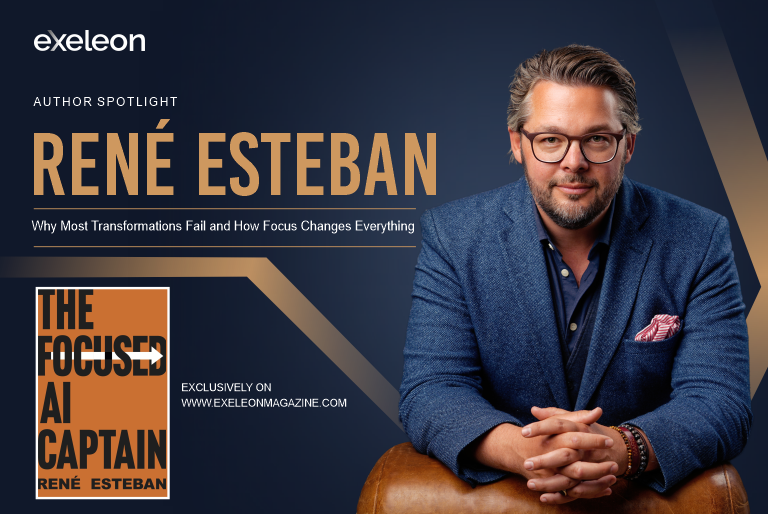
After more than two decades working at the intersection of strategy, technology, and organizational change, René Esteban has seen nearly every version of transformation success and failure imaginable. From early e-commerce waves to today’s AI-driven disruption, he has advised global enterprises under intense pressure to modernize, scale, and stay relevant.
As Founder and CEO of FocusFirst, and author of The Focused AI Captain, René is known for cutting through hype with clarity. His work challenges a popular assumption in modern business: that failed transformations are technology problems. Instead, he argues they are almost always people, design, and focus problems.
In this conversation, René reflects candidly on the failures that shaped him, the patterns he sees across hundreds of transformation programs, and why slowing down at the start is often the fastest way forward.
You have more than two decades of experience leading strategy, change, and transformation across multiple technological waves. Looking back, what moments or failures most shaped how you think about transformation today?
Honestly? The failures shaped me far more than the wins.
My first real job in transformation was leading e-commerce for a DAX-40 company. I was young, I had the CEO behind me, and I thought that meant I could bulldoze through anything. I couldn’t. The sales teams saw us as a threat to their commissions and they fought back – hard. We eventually figured out that we had to redesign their incentive structure so they weren’t punished for online sales in their territory. Only then did they become allies. That taught me something I’ve never forgotten: you can have the best technology and the strongest executive sponsorship, but if people feel threatened, they’ll find ways to slow you down.
Later, I made a different kind of mistake. I was so focused on getting things delivered that I didn’t pay enough attention to whether people were actually adopting them. We’d celebrate go-live and move on to the next thing, then wonder six months later why adoption was flat. I was measuring the wrong things.
These days, when I walk into a new engagement, I assume I’m going to encounter both of those problems – fear and premature celebration. Usually I’m right.
Before founding FocusFirst, you worked closely with large global organizations under intense pressure to deliver results. What gaps did you consistently observe in how companies approached change?
The most common one is rushing to solutions before really understanding the starting point. I’ve seen leadership teams authorize massive technology investments based on a vision deck and some vendor demos, without ever asking: “Do we actually have the organizational readiness to absorb this?” It’s like buying a Speed Boat when you haven’t learned to drive.
The budget split is another giveaway. Most organizations put 80% of their transformation budget into technology and 20% into everything else—training, change management, process redesign. The companies that actually scale their initiatives flip that ratio. They invest 70% in people and processes, 20% in infrastructure, and only 10% in the algorithms themselves. That sounds counterintuitive until you realize the algorithms are useless if nobody trusts them or knows how to use them.
And then there’s the “declare victory and move on” problem. Go-live gets celebrated, the project team disbands, and everyone assumes the transformation is done. It’s not. It’s barely started. The real work is making the new way of working stick when nobody’s watching anymore.
You have worked on more than 250 global transformation programs. From that experience, what patterns separate transformations that succeed from those that quietly fail?
The successful ones usually have one clear goal that everyone can articulate. Not five strategic priorities—one. When I ask people at different levels of an organization “What are we trying to achieve?”, and they give me the same answer, that’s a good sign. When I get five different answers, we have a problem.
Another pattern: the organizations that succeed are the ones that were honest about their starting point. They did the diagnostic work. They admitted where they were weak. The ones that fail often skipped that step because someone in leadership didn’t want to hear uncomfortable truths.
I’ve also noticed that the successful transformations almost always have someone – usually not the most senior person – who just refuses to let adoption slip. They track it obsessively. They follow up when numbers drop. They notice when a team is struggling and intervene early. It’s not glamorous work, but it makes all the difference.
The pattern I see in failures? Lots of activity, lots of pilots, lots of announcements, but when you look closely, nothing actually changed in how people work.
Your book, The Focused AI Captain, challenges the assumption that failed AI initiatives are a technology problem. What made you realize that organizational design is the real bottleneck?
I kept seeing the same thing over and over: organizations would run successful pilots, prove the technology worked, and then… nothing. The pilot would just sit there. No scaling, no broader adoption, no business impact.
At first I thought maybe the pilots weren’t compelling enough. But that wasn’t it. The ROI was often clear. The problem was everything around the technology – unclear ownership, processes that didn’t accommodate the new tools, middle managers who felt bypassed, employees who were never trained properly.
What really drove it home for me was watching how people actually behave. In a lot of organizations, employees have access to approved AI tools that went through months of security review. And what do they do? They use ChatGPT on their personal phones instead because it’s easier and nobody told them why the company tool matters. That’s not a technology failure. That’s a change management failure.
The organizations that get real value from AI aren’t the ones with the most sophisticated models. They’re the ones that did the unglamorous work of preparing their people and redesigning their workflows.
As someone who advises C-suite leaders globally, what do you believe today’s executives misunderstand most about leading through rapid AI driven change?
There’s enormous pressure right now to move fast. I get it – the board is asking about AI, competitors are announcing initiatives, nobody wants to be left behind. But this pressure often leads to what I call “pilot theater”: launching lots of experiments to show activity, without any real plan to scale them. Not focused.
The executives who actually end up moving fastest are, counterintuitively, the ones who slow down at the beginning. They take time to align their leadership team, to be honest about organizational readiness, to think through how roles will change. That upfront, focused investment pays off later because they’re not constantly firefighting resistance and confusion.
The other big misunderstanding is treating AI like it’s just another IT project. It’s not. When AI works well, it changes how decisions get made, how work gets allocated, how people collaborate. Those are organizational design questions, not technology questions. I’ve watched technically brilliant AI deployments fail because nobody thought through what happens to the people whose jobs just changed.
You are recognized as an innovator, speaker, and advisor, yet your work emphasizes focus and simplicity. How do you personally stay focused in an environment full of noise and hype?
I’m not sure I’d call myself an expert at focus – I’m human, so I struggle with it like everyone else. However, what helps me is having a small number of questions I keep returning to. The main one is: “What problem are we actually trying to solve?” It sounds obvious, but it’s amazing how often I catch myself (or a client) drifting toward a solution before we’ve really nailed down the problem.
I also try to be ruthless about what I read. There’s so much AI content out there right now, and most of it is either hype or repackaged hype. I’ve found that talking to practitioners – people actually implementing this stuff – is worth more than reading ten trend reports.
The other thing, honestly, is having people around me who will tell me when I’m wrong. It’s easy to fall in love with your own ideas, especially when you’re the one running the company. My colleagues are pretty good at bringing me back to earth.
Looking ahead, what is your long-term vision for FocusFirst and for the leaders who apply the principles outlined in The Focused AI Captain?
I want FocusFirst to be the place leaders turn when they’re serious about transformation but tired of the usual consulting playbook. We’re building solutions that work in the real world, not just in pitch decks. The goal is to make good transformation practice accessible – not everyone can afford a Big Four firm for two years, but everyone deserves practical guidance.
For the people who read the book, I hope they come away feeling like transformation is something they can actually do. Not that it’s easy – it isn’t – but that it’s not some mystical capability only certain organizations possess. The principles are learnable. The frameworks are practical. You can start applying them Monday morning.
If I’m being honest about the long-term vision, it’s pretty simple: I want fewer transformation programs to fail. The failure rate right now is embarrassing for our entire industry. I think we can do better, and I’m trying to do my part.