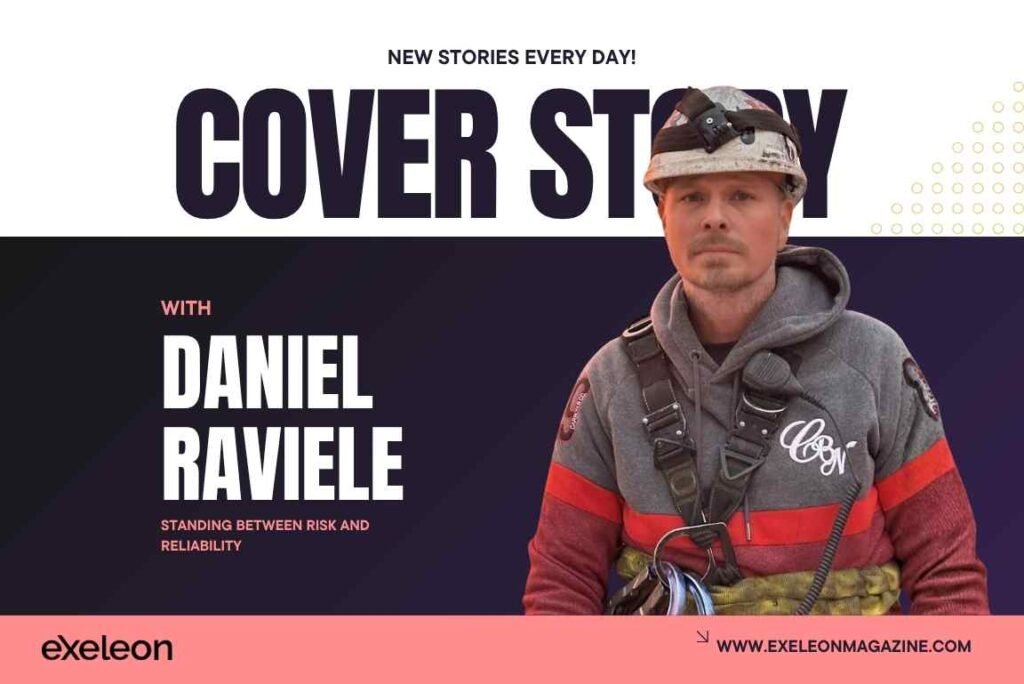
Every skyline tells a story. Behind every rising tower, every stretch of steel and glass reaching into the sky, there is a silent force making it possible. Tower cranes, towering above cities, serve as the backbone of modern construction. Yet behind those cranes, ensuring their safety, precision, and reliability, stand professionals whose work often goes unseen. Daniel Raviele is one of those professionals. His career has been defined not by what he builds, but by how he protects what others build, ensuring that progress never comes at the cost of safety.
For Daniel, the journey into tower crane inspection did not begin as a calculated career decision. It began with fascination. Early in his career, while working on construction sites with Avenue Building Corporation, he found himself drawn to the cranes that dominated the skyline. These machines were more than equipment. They were lifelines for the entire operation.
“My initial interest in tower crane inspection grew out of a fascination with how these massive machines shape skylines and enable complex construction projects,” he explains. “They are truly the backbone of high-rise work. They are the heart of the job.”
What began as curiosity soon became purpose.
Daniel Raviele: Finding Purpose on the Job Site
Working closely with crane maintenance crews exposed Daniel to the complexity and precision required to operate these machines safely. Each lift demanded coordination between operators, riggers, engineers, and inspectors. Every movement had consequences. Every component mattered.
An early opportunity to work directly within the tower crane maintenance division deepened his understanding of the mechanical and structural forces involved. He saw firsthand how load dynamics, structural alignment, and mechanical integrity determined the safety of operations.
But one moment in particular would permanently shape his perspective.
During a major high-rise project early in his career, Daniel was part of the maintenance team when a routine lift revealed a minor fault in the crane’s setup. The issue was caught in time, preventing what could have become a serious incident. Yet the experience left a lasting impression.
“That experience really opened my eyes to how even small oversights can have serious consequences,” he recalls. “From that point on, I became deeply focused on safety, especially crane inspection, where attention to detail truly saves lives.”
It was a turning point. The responsibility was no longer abstract. It was personal.
From that moment forward, Daniel understood that crane inspection was not simply technical work. It was work that carried profound human impact.
Building Expertise Through Discipline and Certification
Daniel’s commitment to safety and technical excellence led him to pursue rigorous professional certifications early in his career. Among his most significant achievements was earning both his Canadian Welding Bureau Welding Supervisor and Welding Inspector certifications.
“It was a rigorous process that required deep technical knowledge and practical experience,” he says. “It opened doors to more complex inspections and leadership roles.”
These certifications enabled him to evaluate structural integrity with precision, ensuring that welds and load-bearing components met strict safety standards. He also obtained certification in Magnetic Particle Non-Destructive Testing, a specialized method used to detect surface and subsurface defects in ferromagnetic materials.
This technique allows inspectors to identify cracks or structural weaknesses that may not be visible to the naked eye. It is a skill that requires both technical understanding and trained intuition.
For Daniel, certification was never simply about credentials. It was about capability. It was about ensuring that he possessed the knowledge and tools necessary to protect lives and projects alike.
His dedication extended beyond personal advancement. Over time, he also contributed to improving inspection protocols, increasing efficiency while reducing risk. Mentoring junior inspectors became another defining aspect of his career.
“Helping others achieve their certifications has been incredibly fulfilling,” he says. “It strengthens the safety culture and ensures long-term impact.”
Facing Pressure Where Precision Matters Most
Few environments test an inspector’s resolve like a tower crane perched atop a high-rise building. The work demands not only technical expertise but composure under pressure.
One of Daniel’s most challenging experiences came during a critical climbing process. A tower crane positioned on a building needed to be secured properly as a severe storm approached. High winds threatened the stability of the structure.
In that moment, there was no room for hesitation.
“I carefully assessed the structure, adjusted supports, and confirmed every brace was secure so the crane could withstand the storm,” he recalls.
The experience reinforced a fundamental truth. Safety depends on foresight. Preparation. And calm decision-making when conditions are uncertain.
“That moment taught me the importance of precision, foresight, and staying calm under pressure,” he says.
The lesson has stayed with him throughout his career.
Balancing Tradition and Technology
The construction industry continues to evolve, introducing new technologies designed to enhance efficiency and safety. Drone inspections, digital monitoring systems, and advanced diagnostics have become increasingly common.
Yet Daniel maintains a firm belief in the importance of direct, hands-on inspection.
“When I started as a crane inspector, most assessments relied on manual checks, which I believe is still the best way to conduct inspections,” he explains. “You need to be physically present on the crane to ensure you are able to detect any discrepancies.”
While he acknowledges the value of technological tools, he emphasizes that technology should complement, not replace, human judgment and physical inspection.
The future, he believes, lies in integration. Combining advanced tools with experienced professionals ensures the highest standards of safety.
Ongoing education remains essential. Daniel regularly participates in workshops, pursues certifications, and stays current with regulatory changes. Continuous learning allows him to adapt while maintaining the integrity of his inspection methods.
The Power of Mentorship and Culture
Behind every successful professional stands the influence of mentors who help shape perspective and discipline. For Daniel, that mentor was Dave Hannah, a senior inspector with decades of experience.
“He taught me that attention to detail and a proactive approach to safety can prevent incidents before they happen,” Daniel reflects.
This philosophy became foundational. Safety, he learned, is not something added to a checklist. It is a mindset.
Today, Daniel carries that lesson forward by mentoring the next generation of inspectors. Through hands-on training and collaboration, he shares real-world knowledge that extends beyond theory.
Mentorship, for him, is about building a culture of vigilance. It is about ensuring that safety is understood not as an obligation, but as a shared responsibility.
Building His Own Legacy
After two decades in the industry, Daniel’s career reached a new milestone with the founding of RTM Crane Inspections Inc. Establishing his own company represented both a professional evolution and a personal commitment to advancing safety standards.
Working alongside leading companies such as Avenue Building Corporation, Total Crane Erection and Dismantle, and Total Design Engineering Firm provided him with the opportunity to apply his experience on complex projects while building strong partnerships.
These collaborations reinforced his reputation as a trusted inspector capable of navigating high-stakes environments.
His vision for RTM Crane Inspections extends beyond business success. He aims to contribute to the advancement of inspection standards while mentoring future professionals.
“I’m passionate about mentoring the next generation of inspectors,” he says. “Helping them navigate both technical challenges and the realities of high-stakes work.”
Lessons From a Career Built on Responsibility
Looking back, Daniel’s career reflects a consistent philosophy. Safety is not achieved through shortcuts. It is achieved through discipline, attention to detail, and unwavering commitment.
His advice to aspiring inspectors is grounded in experience.
“Embrace ongoing learning, and never compromise on safety,” he says. “The highs, like preventing incidents on critical sites, are incredibly rewarding. The lows teach resilience, meticulous planning, and the value of teamwork.”
He also emphasizes the importance of maintenance and prevention.
“Ensuring tower cranes are maintained properly and regularly is the best way to ensure safety.”
And then, with a touch of humor that reflects the realities of working hundreds of feet above ground, he offers one final piece of advice.
“Don’t look down.”
The Silent Guardians of Progress
Daniel Raviele’s work exists largely outside public view. Yet his impact is visible in every crane that operates safely, every project completed without incident, and every worker who returns home at the end of the day.
His career stands as a testament to the professionals who operate behind the scenes, ensuring that progress never comes at the cost of safety.