In an increasingly connected world, communication is often assumed to be seamless. Businesses span continents, classrooms are more diverse than ever, and global events bring together voices from every corner of the world. Yet, one barrier continues to persist quietly but powerfully – Language.
It is one of the most fundamental aspects of human connection, and at the same time, one of the biggest limitations to it. For millions of people, being present in a meeting, a classroom, or a conference does not always mean being able to participate.
Wordly was built to change that.
As a pioneer in real-time AI-powered translation and captioning, the platform enables people to understand and engage in live conversations instantly, in their preferred language. No interpreters, no downloads, no special equipment. Just access.
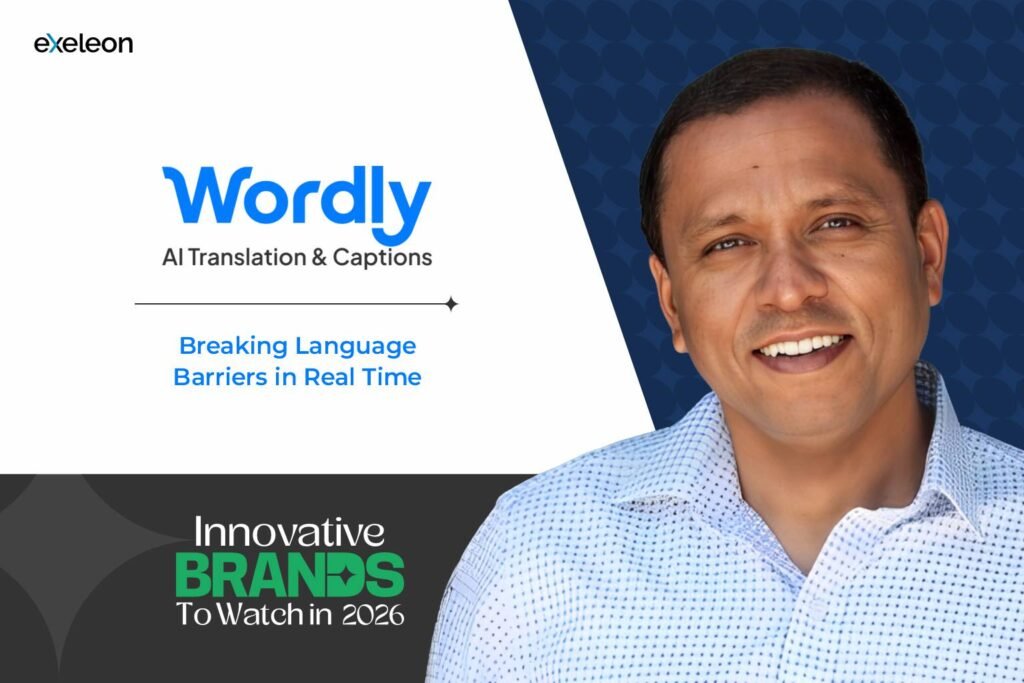
For Lakshman Rathnam, Founder & CEO of Wordly, the mission is clear: remove language barriers so that communication becomes truly inclusive.
A Personal Moment That Sparked a Global Solution
The idea for Wordly did not begin in a lab or through market research. It started with a personal experience that highlighted a global problem.
At a conference in Japan, Lakshman found himself surrounded by experts sharing valuable insights. Yet, despite being physically present, he could not understand what was being said.
“I was physically present, but effectively excluded, not because of a lack of expertise, but because of language,” he recalls.
That moment revealed something deeper. Valuable ideas were being shared, but not everyone in the room had access to them. Traditional solutions, such as in-person interpreters, were limited by cost, scalability, and logistics.
Technology, however, offered a different path.
That realization became the foundation for Wordly.
Today, the platform supports more than 60 languages, serves over 6 million users across 120 countries, and is used by more than 5,000 organizations. From corporate meetings to classrooms, government sessions to religious gatherings, Wordly is helping people participate fully in conversations that were once inaccessible.
The Hidden Scale of Language Barriers
Language barriers are often underestimated because they are not always visible. But their impact is widespread and significant.
In the United States alone, more than 67 million people speak a language other than English at home. Globally, the number reaches into the billions.
The consequences extend far beyond inconvenience.
In government settings, language barriers can limit access to critical information and civic participation. In healthcare, they can affect patient understanding and outcomes. In education, they can prevent students from fully engaging with lessons. In workplaces, they can reduce collaboration and limit career growth.
At a deeper level, the issue becomes one of inclusion.
“When people cannot fully understand or be understood, they are effectively excluded from participation,” Lakshman explains.
Wordly approaches this challenge not just as a technical problem, but as an opportunity to create more equitable access to communication.
A Seamless Experience Built on Complex Technology
While the problem Wordly addresses is complex, the experience it delivers is intentionally simple.
From a user’s perspective, the process is straightforward. An event organizer shares a link or QR code. Participants join through a browser on their phone, tablet, or laptop. No apps, no downloads.
Once inside, users select their preferred language. As the session begins, Wordly processes spoken audio in real time, using AI speech recognition and translation to deliver captions or audio translation within seconds.
This allows participants to follow along as conversations unfold, without delay or disruption.
Behind this simplicity lies a sophisticated system designed to handle real-world conditions. The platform accounts for background noise, accents, overlapping speakers, and specialized terminology, all while maintaining speed and accuracy.
For organizers, the value extends beyond live translation. Wordly provides real-time transcripts, recordings, and translated captions, creating a comprehensive record of each session. These can be used for compliance, documentation, or content reuse, turning conversations into lasting resources.
Features like custom glossaries further enhance accuracy, especially in fields such as healthcare, legal, and technical industries where precision is critical.
The result is a solution that feels effortless for users while delivering powerful capabilities behind the scenes.
Scaling Inclusion at a Global Level
Building a platform for real-time translation is not just a technical challenge. It is a balancing act between speed, accuracy, and scale.
“Real-time translation is complex, especially in live environments,” Lakshman notes.
To address this, Wordly has continuously advanced its AI models and optimized its infrastructure for high-volume, real-time communication. The platform is designed specifically for live use cases, rather than static text translation, ensuring reliability even in demanding environments.
Trust has also been a critical factor.
Organizations using Wordly often operate in high-stakes settings, where accuracy and uptime are essential. To meet these expectations, the company has invested in enterprise-grade infrastructure, security protocols, and rigorous testing.
At the same time, the platform maintains a simple, frictionless user experience. This balance between complexity and usability is what allows Wordly to scale globally without losing accessibility.
Redefining Innovation Through Accessibility
In many industries, innovation is often associated with technological breakthroughs. Wordly takes a broader view.
“What makes Wordly innovative is its ability to deliver real-time, multilingual communication at scale without friction,” Lakshman explains.
The platform combines advances in AI speech recognition and translation with a cloud-native architecture that allows thousands of participants to access live translation simultaneously.
But beyond the technology itself, innovation lies in how that technology is delivered.
By removing the need for apps, downloads, or specialized hardware, Wordly eliminates traditional barriers to adoption. It ensures that anyone, regardless of technical expertise, can access the platform instantly.
This focus on usability and inclusivity is what transforms innovation into impact.
The company’s recognition on the Inc. 5000 list of fastest-growing private companies reflects both the demand for language access and the effectiveness of its approach.
A Future Without Language Barriers
Looking ahead, Wordly’s vision is both ambitious and transformative.
The goal is not just to improve translation, but to make language barriers disappear entirely from live communication.
“We see Wordly evolving into a universal language layer embedded across every type of interaction,” Lakshman says.
This includes meetings, events, education, customer support, and public services. The idea is to create a world where people can communicate freely, without needing to think about language at all.
Future developments are expected to include deeper integration with enterprise platforms, more advanced speech-to-speech capabilities, and enhanced contextual AI that improves understanding in specialized domains.
These advancements move beyond translation toward something more fundamental: real-time understanding.
Transforming How the World Connects
Wordly operates at the intersection of technology and human connection.
By addressing one of the most persistent barriers to communication, it is enabling more inclusive participation across industries and geographies. It is not just making conversations easier, it is making them accessible to people who were previously excluded.