Most AI music tools work the same way: you type a prompt, the model generates audio, and you accept or discard the result. There’s no visibility into the creative decisions being made, no way to redirect before the output is locked, and no architectural structure behind the notes.
Song Agent takes a different approach. Before generating a single note, it shows you a complete Musical Blueprint — the proposed song structure, key signature, tempo, instrumentation, and style markers — and lets you review, adjust, or approve it before composition begins. That single workflow distinction separates it from every other AI music generator currently available.
What Is SongAgent?
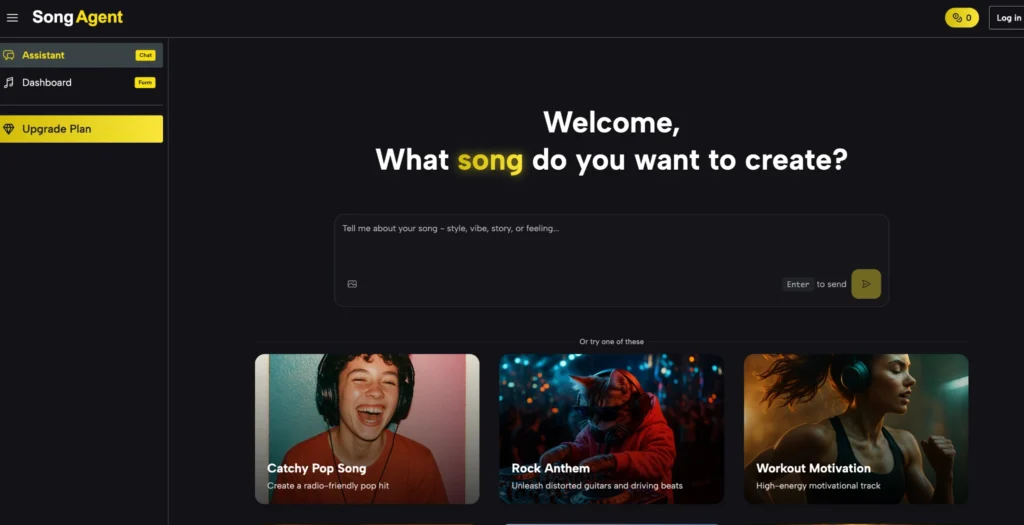
SongAgent is a conversational AI music creation platform that generates professional-quality, copyright-free songs through natural language interaction. Built on a music-theory-aware engine, it goes beyond prompt-to-audio generation to function as a full end-to-end production system: composition, arrangement, lyrics, mixing, mastering, and export in a single workflow.
The platform is built by WhaleSwing LLC and targets a broad user base — from complete beginners who have never composed a bar of music, to professional content creators who need a reliable, scalable pipeline for original tracks.
6 Features That Make SongAgent Structurally Different
1. The Musical Blueprint: Review Before You Generate
This is SongAgent’s most operationally significant differentiator. When you describe a song concept — say, “an uplifting acoustic folk track with warm vocals and gentle guitar fingerpicking for a travel documentary” — the AI Song Agent does not immediately produce audio. Instead, it first presents a detailed Musical Blueprint: the proposed song structure (intro, verse, chorus, bridge, outro), key signature, tempo (BPM), instrumentation choices, and overall style parameters.
You review this plan and can approve it or redirect it in plain language before any rendering begins. This pre-generation review step eliminates the most common frustration in AI music workflows: spending credits and time on outputs that misunderstood the brief from the start.
No other major free AI music tool currently offers this level of pre-composition transparency.
2. Batch Song Creation — Albums and Soundtracks in One Session
Most AI music platforms generate one track per session. SongAgent’s Batch Composition Engine is architected for multi-track production. Users can describe an entire album concept, an EP, a podcast music package, or a game soundtrack, and the system produces the full collection in a single session — maintaining stylistic and thematic consistency across every track.
Internally, this uses specialized parallel AI components (Composer, Arranger, Producer, Mixer) that collaborate to ensure each track in a batch is individually composed while remaining coherent with the others. For a video game developer needing distinct themes for six different levels, or a YouTuber building a brand music identity across 12 intro variations, this is a capability that has no equivalent in tools like Suno, Udio, or standard Suno-derived wrappers.
3. Dual Output System — Two Unique Versions Per Generation
Every generation on SongAgent produces two distinct versions of the requested track simultaneously. Users compare both outputs and select the one that better matches their creative intent — or use elements from each to inform a refinement request.
This A/B output model reduces iteration cycles significantly. Instead of generating, evaluating, re-prompting, and generating again, users start with two alternatives and can pinpoint exactly what to keep or change in the next conversational turn.
4. Conversational Real-Time Refinement
SongAgent’s chat interface is not just an input field — it’s a live production session. After initial generation, users continue the conversation to request adjustments: “make the chorus more energetic,” “remove the drums and keep only strings,” “create an instrumental version,” or “shift the key up a third.” The system adapts in real time without starting over.
This conversational refinement loop mirrors the working dynamic of a human producer in a studio session, where direction, feedback, and iteration happen through natural language rather than software parameters.
5. Professional Production Tools Built In
SongAgent includes a full post-generation toolkit that most AI music platforms charge separately for or don’t offer at all:
- Extend Song: Intelligently elongates a track while preserving its musical character — useful for long-form video content, live sets, or film scoring
- Vocal Separation: Isolates vocals from instrumentals, producing separate stems
- Stems Export (up to 10 tracks): Downloads individual instrument layers for mixing in external DAWs
- MP3 to WAV Converter: Upgrades outputs to lossless quality for broadcast and commercial delivery
- Professional Mixing and Mastering Dashboard: Manages multiple active projects simultaneously with access to mixing and mastering tools
These capabilities are available starting from the free plan, which is a meaningful distinction from competitors who gate stem exports and lossless downloads behind paid tiers.
6. No-Login Free Tier with Private Generation
SongAgent allows users to start creating immediately without registration or a credit card. The free tier includes private generation (tracks are not made public), unlimited chat interaction, MP3 and WAV downloads, vocal separation, and stem exports up to 10 tracks.
This is a substantially more capable free tier than most competitors offer. Platforms like Suno’s free plan make all generations public; Udio’s free tier limits exports; many others require account creation before generating anything. SongAgent’s default is private, immediate, and no-barrier.
How the SongAgent Workflow Actually Works
The complete creation flow from idea to export follows five steps:
Step 1 — Describe your vision. Use plain language to communicate genre, mood, tempo, instrumentation, and purpose. Detail improves results, but simple descriptions work too. Example: “a dark lo-fi hip-hop instrumental for late-night study sessions, heavy reverb, slow BPM, muted bass.”
Step 2 — Review the Musical Blueprint. The AI Song Agent analyzes your description using music theory principles and presents the proposed composition plan. Review structure, key, tempo, and instrumentation. Approve or redirect before any audio is rendered.
Step 3 — Generate and compare. Receive two distinct versions of your track. Compare outputs and select the better foundation.
Step 4 — Refine through conversation. Describe what to change. The system adapts iteratively until the result matches your vision exactly.
Step 5 — Export in professional formats. Download MP3 or WAV, export stems, apply the Extend Song feature for longer versions, or use the Vocal Remover for stem isolation. Tracks are royalty-free with full commercial rights on paid plans.
Who SongAgent Is Built For
Content creators and YouTubers who need a consistent music identity across dozens or hundreds of videos — without copyright exposure — can use Batch Creation to build an entire branded music library in one session.
Independent filmmakers and game developers needing thematically consistent soundtracks across multiple scenes or levels benefit most from the Batch Engine’s style-coherent multi-track output.
Podcasters who need professional intro, transition, and outro packages without paying per-track licensing fees.
Musicians and producers who want to test arrangement ideas rapidly before committing to manual production. The Blueprint review step is particularly useful for composers who want AI-generated structural drafts to build on.
Beginners with no music theory background who can describe what they want emotionally (“a song that feels like the last day of summer”) and receive structured, coherent music that reflects that intent — not random notes that technically match a genre tag.
SongAgent vs. Other AI Music Generators
| Feature | SongAgent | Typical Competitors |
| Musical Blueprint preview | Before generation | Prompt → audio, no review |
| Batch multi-track creation | Albums, EPs, soundtracks | One track per session |
| Dual output per generation | Two versions to compare | Single output |
| Stems export (free tier) | Up to 10 tracks | Paid only or unavailable |
| No-login free access | Immediate, private | Often requires signup |
| Free generations public? | Private by default | Public on most free plans |
| Conversational refinement | Real-time chat editing | Limited or none |
| Built-in mastering tools | Included in dashboard | External tools required |
Final Assessment
SongAgent’s core value proposition is clear: it treats music generation as a structured, collaborative process rather than a one-shot prompt experiment. The Musical Blueprint review step, Batch Composition Engine, Dual Output system, and built-in production toolkit collectively create a workflow that is architecturally more sophisticated than any single-generation competitor.
For creators who need original, commercially safe music at scale — and who want visibility and control over the creative direction before committing to a render — AI Song Agent is the most capable free starting point available today.