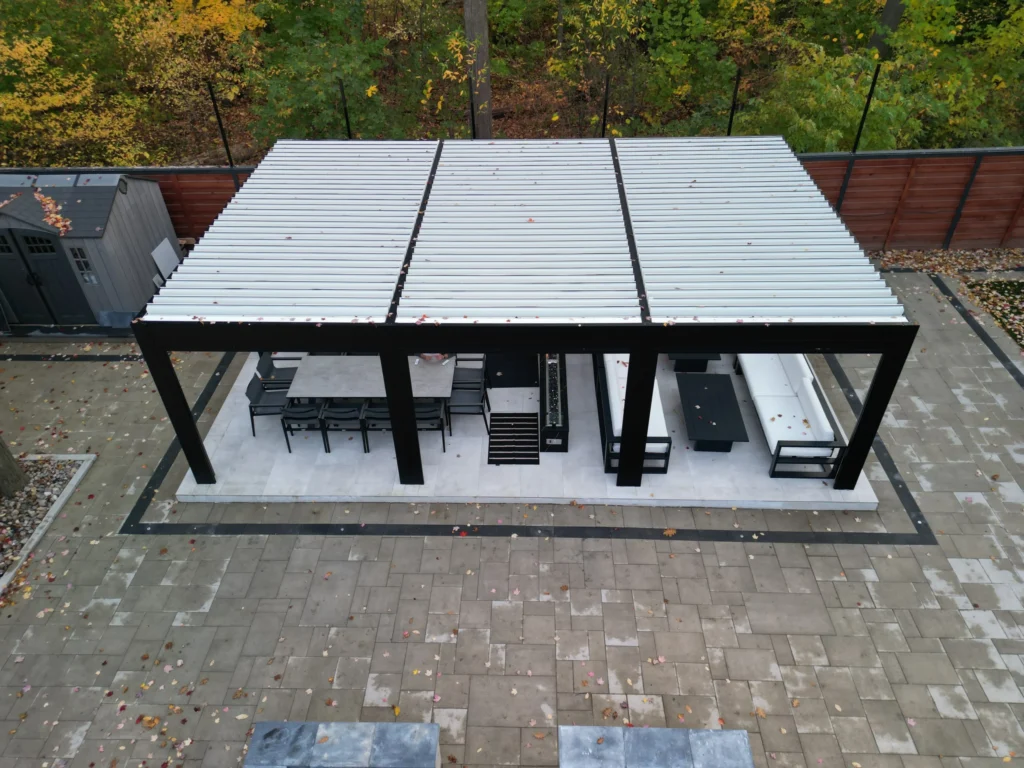
A smart louvered pergola combines outdoor architecture with automation technology. It is designed to automatically manage sunlight, ventilation, and rain protection. These systems are used in residential and commercial spaces where consistent outdoor comfort is required with minimal manual adjustment.
What Makes a Pergola “Smart”
A smart pergola uses electronic controls for adjustable roof slats. The structure contains sensors, motors, and control units. Users can adjust settings manually or use automated controls.
Core components include:
Motorized louver system.
Environmental sensors (sun, rain, wind).
Remote control or mobile app interface.
Automated safety positioning.
Programmable settings.
These systems reduce manual adjustment and maintain optimal outdoor conditions automatically.
Weather-Adaptive Features
Smart pergolas respond to environmental changes in real time. Sensors detect weather conditions and adjust roof position automatically.
The system uses rain sensors to close louvers, which stop water from entering the building. Wind sensors adjust or lock the structure to protect against mechanical stress. Sun sensors control slat angles to create stable shade conditions throughout the day.
The system automatically protects outdoor furniture and simplifies space usage since it needs no user interaction.
Energy and Lifestyle Benefits
A smart pergola can effectively reduce air conditioning demand during summer months by eliminating direct solar heat gain into adjacent indoor spaces.
Main benefits:
Automatic climate control.
Reduced energy consumption.
Consistent outdoor comfort.
Protection of outdoor furniture.
Increased daily usability of outdoor space.
These systems also boost lifestyle convenience by handling adjustments automatically during weather changes.
Integration with Smart Homes
Modern smart pergolas connect to home automation systems. Users control settings through mobile applications or voice assistants. The system enables users to manage all devices from a single interface, which works with Google Home and Alexa.
The system enables users to schedule automation features using two methods: time-based scheduling and weather-forecast-based scheduling. Some systems also sync with other outdoor devices, such as lighting and heating elements.
The outdoor area becomes a single smart space through this integration process.
Future Trends
Future pergola systems will include more advanced AI-based automation. Predictive weather response, adaptive shading algorithms, and energy optimization are expected in future systems.
Material improvements will focus on lighter, higher-strength structures. Solar-powered pergolas are also being developed for energy-independent operation.
Commercial spaces will increasingly adopt smart pergolas for adaptive outdoor environment control in hospitality and retail sectors.
The smart louvered pergolas provide outdoor spaces with their advanced automated weather control system. The system uses structural engineering methods and automatic control systems to deliver optimal comfort solutions. The smart outdoor systems are now establishing themselves as the current standard through three features: sensor operation, smart home connectivity, and energy-efficient design.