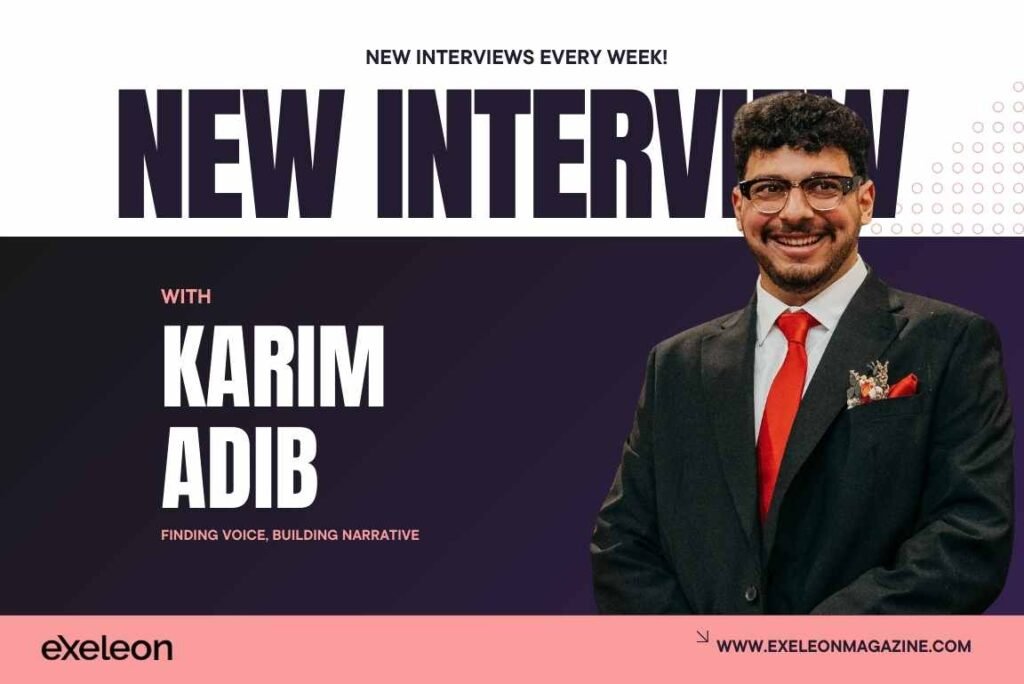
Karim Adib’s journey into leadership and digital PR did not follow a straight line, but it was shaped early by curiosity, initiative, and the instinct to speak up when others hesitated. Raised as an only child in Cairo, he learned to navigate social dynamics independently, a foundation that quietly prepared him for leadership long before he recognized it as such. Over the past seven years, Karim has built a career across some of the UK’s largest agencies, working at the intersection of SEO, digital PR, and storytelling.
Today, as Senior Digital PR Manager at Search Atlas, he focuses on shaping brand narratives in a rapidly evolving media landscape. In this conversation, Karim reflects on his roots, the evolution of digital PR, and the role creativity and trust play in building lasting visibility.
Talk to us about your journey, your roots, and what is your earliest memory as a leader?
Karim Adib: Growing up as an only child in Cairo, Egypt taught me to be socially proactive from a young age. In Egypt, most families have three or four children, and I quickly realized I needed to adapt to stand out in those social dynamics.
Without siblings introducing me to their friends or make social situations less awkward, I had to take the initiative myself. I learned to speak up first, approach people directly, and suggest ideas for things to do.
Being proactive was the only way I could build friendships and create my own social circle. My main thesis was that if I came up with the most fun games or was the funniest to be around, then I could get people to be my friends. And so I was slowly being molded into a leader without realizing it.
Another leadership trait that I developed when I was very young, but didn’t recognize as leadership at the time, was speaking up first. I started to notice that in class, a lot of people were scared to ask questions, and in PE classes people were afraid to step up and be the person to pick teams. I realized that if I was brave enough to be the first to speak, I could get a lot more opportunities.
As a result, I was picked to lead many different projects, and people who didn’t want to speak first would team up with me because I saved them the embarrassment of doing so. But I never thought of it that way. I just wanted more opportunities.
You have spent over seven years working in digital PR, including roles at some of the UK’s largest agencies. What first drew you to the PR industry?
Karim Adib: I first studied civil engineering at university because I liked math and thought engineering would make the most sense. But after three long years in the degree, the job itself never appealed to me.
I graduated during Covid, when job opportunities were very scarce. However, I knew I wanted to get into marketing because it brought two of my favorite passions together: business and creativity.
I was initially drawn to the SEO industry because it felt more methodical, which aligned well with my engineering background. When I applied to a few SEO agencies, the one that accepted me offered a role either in the SEO department or the newly created PR department. As someone who loves building things, enjoys a challenge, and was intrigued by this emerging digital PR discipline, I chose digital PR.
The reason I continued working in digital PR is that it introduced a third passion I didn’t know I had: storytelling. I could now combine business, creativity, storytelling, and my math skills to bring something unique to every PR department I worked in.
Digital PR has evolved rapidly over the last few years. From your perspective, what has changed the most in how brands approach online visibility and authority?
Karim Adib: In the digital PR of old, there was a strong emphasis on links. Having worked across every part of the industry, from guaranteed links to in-house digital PR with traditional PR metrics, I’ve seen a lot of change, but nothing like what’s happened in the past year.
Over the last year, digital PR has become incredibly scalable due to AI tools. People can now produce what they believe are strong campaigns at scale, but AI can only pattern-recognize its way through PR. This results in the same stories being pitched to the same journalists year after year, with more people competing for the same limited attention.
At the same time, businesses have started to realize that Google is not the be-all and end-all of search traffic. Many began focusing more on social platforms, and now AI search is emerging as a significant traffic source. As a result, companies are seeing that links at any cost, or mundane campaigns that don’t connect to commercial outcomes, often fail to drive real business results, leading to weaker returns on PR investment.
You are currently leading PR efforts at Search Atlas. What does your role involve, and how does it differ from agency-side work?
Karim Adib: I’m currently the Senior Digital PR Manager at Search Atlas, and my role has shifted significantly from agency work. In agencies, your primary KPIs are set early on, and you might work with a client for one month or six months, but you rarely get to shape an entire company’s narrative.
At Search Atlas, I get to see how my PR efforts impact the broader brand. I have input into social media, website messaging, copy, customer service, and more. My role has evolved from being purely a PR function to a broader communications role focused on how the brand is perceived overall.
The quality of work I deliver is higher because I have more time and trust from the brand. In agency settings, clients don’t always offer that same level of flexibility or trust.
In your opinion, how is the PR and media landscape across Africa evolving, especially in relation to global brands and digital-first storytelling?
Karim Adib: I can’t speak for every country in Africa, but I can comment on broader trends, particularly those I’m seeing in the Middle East.
Companies are starting to invest more in SEO and PR, whereas previously these areas received less focus. Campaigns were often advertising-driven and heavily centered on social media, but now brands are diversifying to ensure they’re present across multiple channels as competition increases.
In terms of content quality, we’re seeing a rise in influencer-led campaigns. Consumers no longer trust brands with the biggest budgets; they trust people. As a result, smaller TikTok creators with niche audiences are landing major brand deals because of the trust they’ve built.
This feels like just the beginning. It’s encouraging for anyone in Africa who can build an audience and earn trust, because brands are currently lagging behind creators. It’s a ripe moment for storytellers and community builders to make their mark in the industry.
What advice would you give to professionals who want to transition from traditional PR into more performance-oriented digital PR roles?
Karim Adib: Traditional and digital PR are converging more than ever, and the distinction between the two is becoming less relevant. If you limit yourself to a single channel, you’re not fully understanding PR or audiences. A care home business still reaches its audience through TV, radio, and newspapers, while an emerging fashion brand must leverage TikTok.
For traditional PR professionals looking to specialize in digital PR, understanding how their work impacts digital visibility is key. Learning how to amplify traditional PR efforts in the digital space is often more than enough.
I believe that in a few years, the title will simply be PR, and this distinction will no longer exist.
Looking ahead, how do you see your career in digital PR evolving over the next few years, and what kind of impact do you hope to make through your work?
Karim Adib: The digital PR space is incredibly exciting right now. While many talk about AI replacing people, digital PR has always required constant evolution and creativity to succeed.
AI is exposing weaknesses in the industry by accelerating a shift toward authenticity. People with real stories, creativity, and strong journalist relationships will stand out. Those chasing quick wins without investing in storytelling or relationships will struggle.
For me, storytelling has always been about inspiration. It’s one of my favorite things to do, and I want to continue refining my craft while inspiring others to do the same.