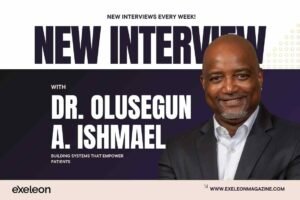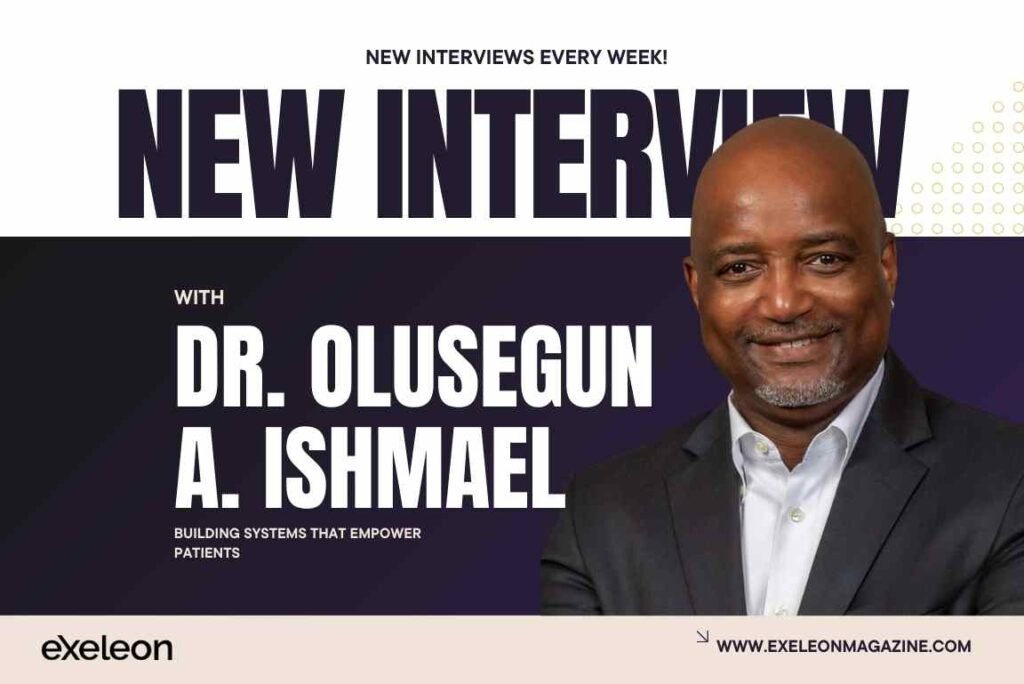
Healthcare leadership is often defined by titles and institutions, but the leaders who create lasting impact are those who understand the system from every angle. Dr. Olusegun A. Ishmael stands among that rare group. From his early experiences as an immigrant child navigating a new country to serving as a physician, hospital executive, and now Founder and CEO, his career reflects a consistent focus on solving structural challenges that affect real patients every day.
With more than two decades of healthcare leadership across major hospitals, payers, and physician groups, Dr. Ishmael has witnessed firsthand how access, systems design, and patient empowerment shape outcomes.
Today, through MIRA Health, he is working to address one of healthcare’s most persistent gaps: helping patients manage their health effectively between clinical visits. In this interview with Exeleon, Dr. Ishmael shares the formative experiences that shaped his journey, the leadership lessons learned across global healthcare environments, and his vision for building a more accessible, equitable, and patient-centered future.
Your journey from immigrating to the United States as a child to leading major health systems is remarkable. What early experiences shaped your drive to pursue medicine and leadership?
I came to the U.S. not speaking English, two weeks before my fifth birthday, and four months before starting school. Public television became my first teacher. Shows like Sesame Street helped me learn English quickly.
My parents shaped my career in many ways. My mother had a degree in midwifery. My father, an industrial engineer. That combination steered me toward medicine and how I think about it: quality, systems, and efficiency.
I was part of the first cohort of Chicago Public Schools’ gifted program, which opened the door to a more rigorous curriculum, especially in science and languages, and it expanded my sense of what was possible.
At 13, we moved to Nigeria, where my father taught engineering. That experience changed my outlook. It taught me there was more to Black history than the American narrative of slavery. Africa wasn’t the stereotype being taught; there weren’t jungles, but cities. Here was a country and a continent with a rich history, complexity, and modern life. It was a period of self-definition.
I finished high school there at a boarding school, and that’s where I learned independence, discipline, and leadership, not in theory, but in daily practice.
I stayed in Nigeria for medical school after my family returned to the States. People ask why, and the answer is simple: hands-on training and free education. And while I was learning to become a doctor, I also learned something bigger: health disparities and how much of health outcome is determined not just by biology, but by access, infrastructure, and systems.
With more than two decades in C-suite healthcare leadership, what have been the most important lessons you’ve learned about building effective and inclusive healthcare organizations?
Over the years, a few lessons have held up in every organization, market, and crisis. To summarize: build systems that respect people, patients, staff, and the community, and performance will follow.
First, culture is the operating system. Strategy fails when people don’t feel respected, heard, and safe to speak up. Psychological safety, accountability, and clarity aren’t “nice to have”; they’re the foundation of results.
Second, patients experience the system exactly as frontline staff do. We used to focus solely on patient satisfaction scores. If staff are battling broken workflows, understaffing, and shifting priorities, patients will feel it immediately. The fastest path to a great patient experience is a great staff experience.
Third, inclusion must be deliberate. Mission statements don’t reduce disparities; processes do. Equity must be built into hiring, promotion, clinical protocols, language access, and how data is used. Done right, inclusion expands opportunity for everyone by removing bias, without trading one group’s progress for another’s.
Fourth, trust is the currency internally and in the community. Communities don’t judge us by our intentions; they judge us by our actions. Show up consistently, listen without defensiveness, partner instead of “parachuting in,” and keep your word, especially when it’s inconvenient.
Fifth, quality and efficiency are our friends. Waste is not neutral; it harms patients and exhausts staff. Reduce variation, fix throughput, and build reliable systems; outcomes improve, and teams can breathe. The goal isn’t to do more with less. It’s to do the right work, the right way, every time.
Lastly, leadership is visibility plus follow-through. In healthcare, people can tell the difference between a leader who visits units and a leader who solves problems. High-performing organizations are those where staff believe that if they raise an issue, something will actually happen.
You are now the Founder and CEO of MIRA Health. What inspired you to create this platform, and what gap in healthcare were you determined to solve?
In my years as an emergency room physician, I’ve often seen patients walk into the ER carrying a bag full of medications, confused about what each pill is for and when to take it. And having served as an executive on the payer side and in hospital administration, I’ve seen the costs when that confusion leads to avoidable admissions or readmissions.
But the real cost isn’t just financial – it’s quality of life; it’s independence lost; It’s families stretched thin. One elderly patient I met in the ER was the final catalyst for me. It made the problem impossible to ignore.
And it’s not only medications; the same gap occurs with prevention. People miss mammograms, colonoscopies, routine labs, and check-ups, not because they don’t care, but because the system makes it hard to keep track, hard to understand what matters, and easy to fall behind. Then the diagnosis comes late, the disease is more advanced, outcomes are worse, and costs rise.
That’s the gap we’re solving. Our healthcare system is built for episodic care, but most people need day-to-day support between doctor visits. We’re excellent at treating illnesses, but far less effective at helping people stay stable, adhere to medications, and maintain preventive care before a crisis occurs.
I felt that if we could help people truly own their health by improving medication adherence and preventive compliance, we could reduce avoidable suffering and costs. That’s why I built the Medical Information Resource Application, MIRA.
MIRA is your health co-pilot: helping you keep track of your medications, understand what you’re taking and why, stay on schedule, and stay current on preventive services so fewer people end up in the hospital.
As an Influential Black Leader in healthcare and technology, what responsibility do you feel to create more equitable access and representation within the industry?
I feel a responsibility to be a voice and a builder. Not because I believe one person can fix inequity, but because visibility without impact is performative. As someone with access to rooms where decisions are made, part of my job is to make sure decisions don’t keep producing the same outcomes for the same communities.
And once you’re given an opportunity, you’re rarely seen as just an individual. You represent more than yourself. That reality may seem unfair, but it’s also clarifying. It raises the stakes. I have to show up prepared, deliver results, and lead in a way that opens doors.
What deepens that responsibility is that I’ve seen inequity from multiple vantage points, the U.S. and Nigeria, the bedside and the boardroom. And across those environments, one theme keeps repeating: the most powerful drivers of inequity are often socioeconomic status and education. Zip code matters. Resources matter. And the system too often assumes time, money, transportation, broadband, and a support network that many people simply don’t have.
So, when I talk about equity, I’m not talking about a concept. I’m talking about patterns I’ve watched play out.
MIRA Health focuses on improving medication adherence and helping patients navigate their health journey. Why is empowering patients with the right tools and information so critical today?
Today’s healthcare system is built around episodes, which have not changed since the days of Hippocrates. However, people live in the in-between. Throw in a shortage of providers and increasing healthcare costs, and we are in the perfect storm.
Most people spend only a few minutes a year with their clinician. But they spend thousands of hours managing their health on their own. That’s where things break down: life happens, medications change, symptoms evolve, insurance rules shift, and preventive screenings get delayed. It’s not that people don’t care. It’s that the system is hard to navigate, and the burden of coordination falls on the patient, often without the tools to do it.
Empowering patients with the right tools and information is critical because adherence is where outcomes are won or lost. If a medication is prescribed but not taken correctly or at all, the clinical plan falls apart. The consequences include avoidable ER visits, admissions, and disease progression.
That’s the “why” behind MIRA. We’re closing the gap between clinical care and everyday life. In a system under strain, patient empowerment should be a core strategy to improve outcomes, experience, and reduce avoidable costs.
Looking ahead, what legacy do you hope to build through your work with MIRA Health and your broader impact on healthcare?
I hope the legacy is bigger than a product, a title, or a single organization.
With MIRA Health, I want to prove something practical and overdue: the most important part of healthcare is what happens between visits. If we can help people understand their medications, stay adherent, and maintain prevention, without requiring them to be clinicians, healthcare workers, or expert navigators, then we can reduce avoidable suffering, prevent unnecessary hospitalizations, and catch disease earlier, when outcomes are better.
More broadly, I want to help shift healthcare from a system that’s great at episodic care to one that’s excellent at everyday support, a system that’s designed for real life.
If I had to summarize it, I want my work to make healthcare feel less like a maze and more like a partnership. And I want to be able to look back and say we didn’t just treat illness; we helped people stay well, own their health, and navigate their health journey with dignity, clarity, and control.
Read Digital Version of the Edition.