Leadership is often associated with consistency, mastery, and staying the course. Yet the leaders who leave the deepest mark are rarely those who remain static. They are the ones who evolve, challenge their own assumptions, and continuously rebuild themselves to remain relevant in a changing world. Dr. Julian Rowa belongs firmly in this category. His career reflects not a single trajectory, but a deliberate pattern of reinvention, intellectual expansion, and bold engagement with complexity.
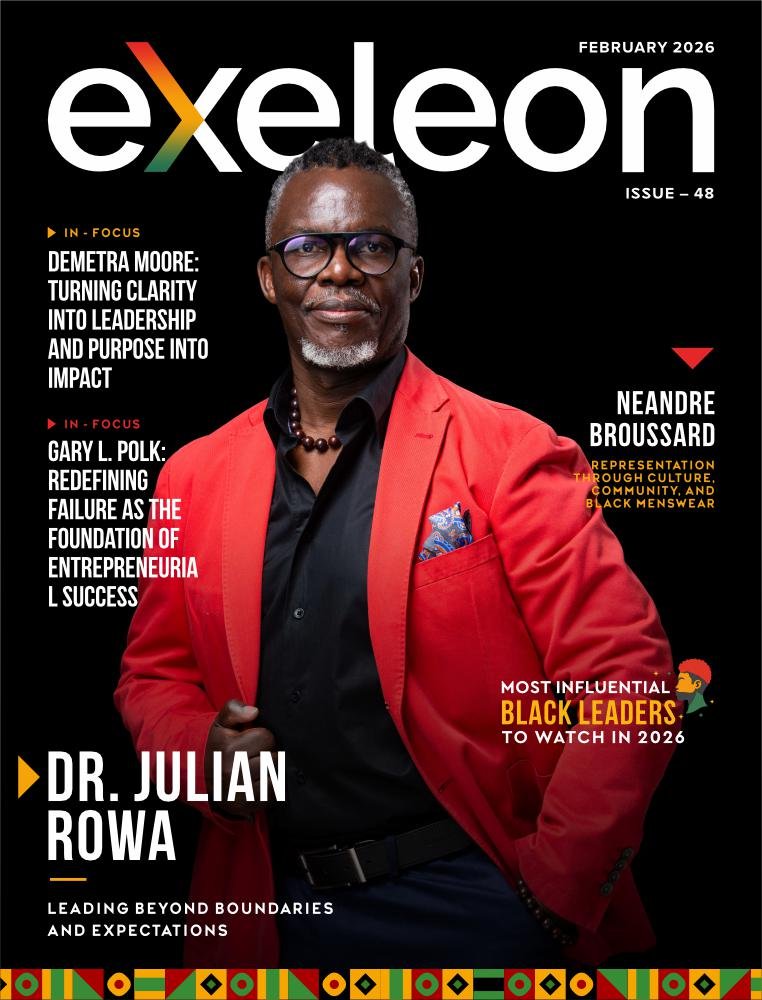
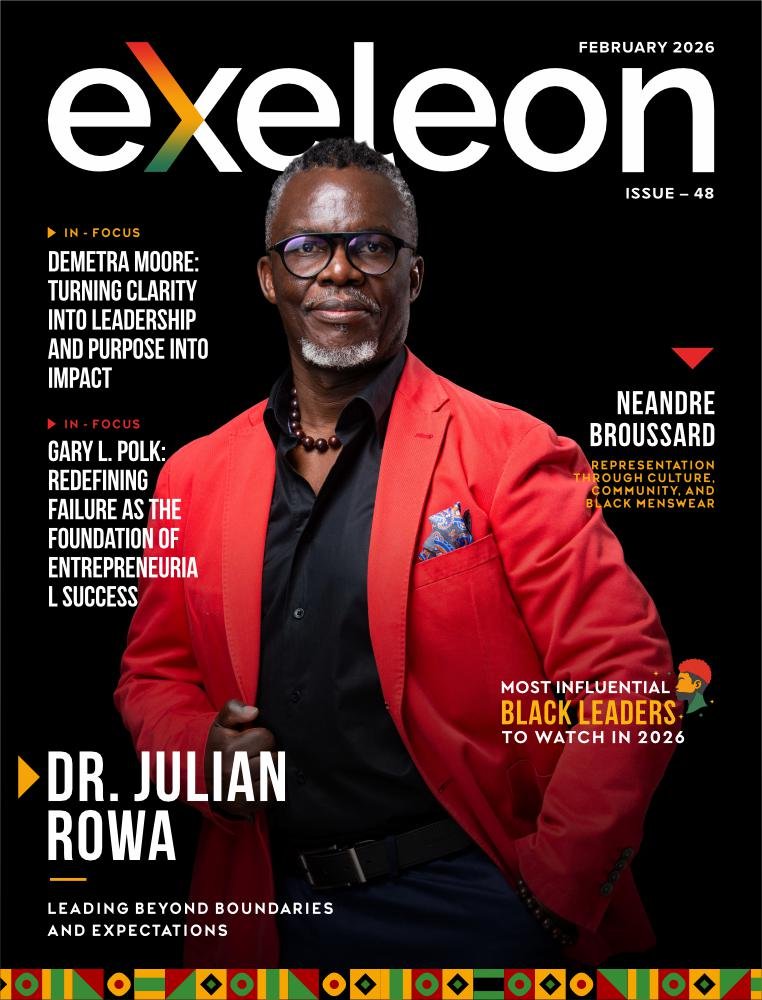
Featuring on the cover of Exeleon Magazine’s Most Influential Black Leaders to Watch in 2026, Dr. Julian Rowa represents a new model of leadership. One that blends practical experience, academic rigor, and a fearless willingness to disrupt himself. His journey spans nearly three decades in banking, senior leadership roles across Africa, international academic pursuit, consulting, and public intellectual engagement. Yet what defines him most is not the titles he has held, but the mindset he has cultivated.
In this candid conversation with Exeleon Magazine, Dr. Rowa reflects on his philosophy of reinvention, the lessons learned across continents and industries, and his vision for leadership in a world defined by constant transformation.
Who is Dr. Julian Rowa, and what is his most compelling attribute?
Outside being an educator and conversational intellectual, Dr. Rowa is your ordinary “fella,” childlike in spirit, a dare attitude and a demeanor to match. My most compelling attribute is a zealous knack to self-disrupt, modify and repackage every two years. This is stimulated by the fundamental change in my circumstances and the environment demanding continuous learning and improvement.
Self-change is the only avenue to remaining current, relevant and rigorous. At 57, I refuse to stand still but morph contingent on the dynamics in vogue guided by the reflective cycle, cycle of self-renewal, Henri Fayol’s where now next and Kurt Lewin’s unfreeze, change and refreeze models.
One can argue you are all over the place. Dr. Julian Rowa Inc. runs 7 unrelated business segments with more auxiliary services. What triggered this new outlook for you noting you were a banker for close to 27 years?
Being specialized is good but not great. Linear thinking is a disaster in waiting and so a multi-faceted approach to problem solving is an asset. It means developing expertise in myriad unrelated but inter-connected fields from which one can draw and harness critical thinking. David Epstein calls it “RANGE.” Granted, Covid taught us a powerful lesson. The new world order has reducing respect for specialism. Think about it, the human capital today stresses innovation, places a premium on creativity and tech, strategic thinking and entrepreneurship above conventional skills. Decentralized Autonomous Organizations is the fad and will demand a universal mindset.
It will also be cheaper, efficient and more effective to contract a resource with manifold know-what and knowhow. A techie who understands product development, project management, transition frameworks, market positioning, business development and research will have an edge. Value for money and relevance will be infinite.
Your career spans banking, international development, consulting, academia, and public discourse. When you look back, what moments or environments most shaped the leader and thinker you are today?
Banking formed and shaped me, built me but it also changed the core of me in a fundamental way at the tail end of my career. I did superbly well in the industry, led and managed at very senior levels and across functions my limitations at the time notwithstanding. Then a day of reckoning came, reflected on those that had served in the sector before me, my late father Mzee John Akula Rowa included. There was a pattern. Most were not fully prepped for the harsh reality that was life after formal employment. With an undeviating outlook to life and with limited transferable skills, an unfavorable ending was imminent. I therefore had to steer my life differently, embarking on a journey of self-improvement and re-invention.
To this end, I worked across functions in the bank, deployed my skills in 3 countries in Africa and pursued education in Europe. I worked for a Multi-national (Barclays), a Pan-African Institution (Stanbic), State Corporation (Consolidated Bank) to the fastest growing regional bank (Equity) picking prized lessons on culture and diverse ways to organize.
Was this sufficient to make me a guru in leadership and management? The answer is no. Away from the pursuit of the bottom-line through revenues and cost management, I moved sectors to the NGO, to acclimatize with managing resource mobilization, capacity development, impact and sustainability. This was new and unsettling. The tenets of driving performance were a different proposition. But this knowledge was still not enough. I still felt deficient.
Then came the hunger for academic credentials. I sought knowledge to expand my thinking. In my doctorate, the objective was to bridge the gap between theory and practice, a rare qualification at the time. Obsessed with generation and dissemination of new knowledge, I quit employment to focus on my Doctorate at University of Liverpool. The need to reflect on, apply and internalize what my MBA and DBA taught me became a fixation. I later founded Shajuls Business and Management Consulting now an offshoot of Dr. Julian Rowa Inc., an attempt to build my own enterprise from scratch.
My thinking and solutions draw from life, work and academic experience i.e. models, concepts and theories. This concoction has helped me lead, manage and solve work place based problems phenomenally, equipped with a strong lens and vigor.
These are what shaped the leader and thinker in me. The lessons I have learned in this three legged stool provides me the impetus to engage in public discourse with confidence at any fora. Solving problems from this multi-faceted approach is fascinating. Each engagement only serves to enriche me.
Growing up and building a career across different cultures and countries, how did your early life and professional roots influence your worldview and leadership philosophy?
I grew up in the ghettos of Nairobi (Jericho), an environment that toughens one. My parents and the thirteen of us lived in a one bedroomed apartment. I went to local schools, and my early work life was in Muranga, a small township in Kenya. I started my career as a teller in a bank and left active employment as an Executive Director of an NGO. I worked across functions, with expatriates from Africa, Europe, Asia and America. My tour of duty covered 3 countries in Africa. I studied in the UK and made friends globally. I developed a helicopter perspective of life that has shaped, influenced and informed my world view. I now recognize that what separates humanity is opportunity and a can do attitude.
My leadership philosophy is therefore founded in empathy, seeking first to understand and situational assessment. Effectively, my life mission is to have meaningful and progressive engagements, with impact for those I come into contact with. I call it leading with sensitivity.
You thrive in complexity and describe yourself as someone who enjoys chaos and solving workplace problems. Where does that comfort with uncertainty come from?
Examining and evaluating complex questions and situations activates lifelong learning making us better. Chaos demands steading before take-off. The adrenaline rush is exciting and the anxiety that ensues makes winning priceless. This mindset came about from my socialization with operations, projects and change management. The art of making the near impossible possible is where I derive joy. Anything less is probably not challenging enough. Meticulous response to a complex problem or chaos stretches imagination.
As the founder of Dr. Julian Rowa Inc., you intervene in a wide range of workplace based challenges and questions. What recurring patterns do you see across organizations regardless of size or sector?
Dr Julian Rowa Incorporated is built on 7 diverse pillars. These are 1) Consulting in organizational analysis, strategic planning, operations efficiency, business development, risk management and entrepreneurship 2) Critical appraisal of Tech innovations such as Blockchain, Artificial Intelligence, Digital Assets and Start-Ups, 3) International Relationship and Diplomacy 4) Coaching and Mentorship/Facilitation and Moderation of corporate events 5) KwehKinte Foundation 6) Image and Fashion (to affirm the man and boy child) and 7) Kar Kweh Sanctuary (A country side resort for solitude and events). Our solutions target corporates, associations, businesses, creatives and individuals. I also develop concepts, train, speak, write and commentate on topical local and global issues.
The recurring patterns organizations across sectors should be aware of and counter include effective execution of strategy, product development protocols, market development and positioning, risk register discipline, strategic human resource management with innovation and change at the center, business continuity, re-invention framework, productivity measurement, need for activity based costing and waste management coupled with unresponsive leadership that focuses on short term fix.
Blockchain, digital assets, and artificial intelligence are areas you actively engage with. What initially sparked your interest in these technologies, and why do you believe Africa must be part of this conversation?
I must admit that I am cynical. Call me a pessimist. To accept an argument as true, useful, and viable, I triangulate data, engage in intense debates, search for requisite information, and conduct research where necessary in an effort to make sense of it.
Blockchain is a decentralized ledger that allows direct peer-to-peer interaction without intermediation. Cryptocurrency is the medium of exchange that runs on blockchain, serving as both a store of value and an investment tool, though its change in value is not underpinned by any known economic principle. AI is positioned as a general-purpose vehicle, a new frontier for work and service delivery purported to be more intelligent than its builders. It also lacks emotional connectivity with users. These interventions sounded fallacious, too theoretical, and almost rhetorical. How would the Internet of Things function in the world I knew? What were the changeover protocols?
These and other questions were disconcerting and so I embarked on a campaign to learn. The early days of dissecting these three items were confusing. Often, I was dismissive of the arguments adduced by experts as I always gave a counter narrative to their submissions. My logical argument jolted their thinking forcing them back to the drawing board. It is then I realized these technologies were in their early stages of development and that they could benefit from an alternative view and input. I found a niche as a Critical Appraiser. Today I focus on the packaging of these technologies, effective communication for different demographics, non techies and senior citizens, strategic and market positioning, operations rigor, transition framework and valuation. I evolved from not knowing, seeing a threat to identifying an opportunity that assures my continued relevance.
Similarly, I had the privilege to interview regional and global experts (in every element) and interacted with opinion leaders and shapers in the field. I have read close to 180 scholarly and practitioner journals and over 15 books. I have participated in seminars that scaffold the discourse and which have enriched my perspective.
Africa must be part of this conversation because the technologies will invalidate boarders as we know them. A new and universal ecosystem awaits and it will alter the modus operandi. To mitigate, Africa must be at the table where these are discussed to champion her interests, contextualize their needs and explore use cases to influence policy.
With such a demanding professional life, how do you maintain discipline, clarity, and balance, both mentally and physically?
To maintain the momentum, discipline and clarity, I read widely, engage in difficult conversations and watch documentaries. Given my work load, I govern myself with a weekly and daily schedules. This includes family time, fun and personal development initiatives. I have and engage with an annual plan that guides the big picture. I self-audit and maintain a critical and accountable friend.
For balance, Fridays are movie nights and family dinner. We take turns to cook. Saturdays belong to myself and my lovely wife Irene Chami whereas Sunday is a family day for worship, shared lunch and a topical area of conversation. I do check-in meetings with my daughter Akweh every week. I am a gym fanatic and a boxer. I love to laugh and be silly. For future, I want to go back to school and learn law, enroll for salsa, and take up sax.
What Mantra do you live by?
I consult the power of my subconscious mind and engage the left hand column in my conversations with myself. It makes me dare.
Beyond titles, publications, and accolades, what kind of legacy do you hope your work leaves within Africa’s institutions, organizations, and future leaders?
To be a Jury Member in the Global Start Ups Awards Africa 2024, to be declared personality of the week by the Nation Newspaper and industry Marven by The Tax Prism journal, as Engage Kenya speaker, I am a regenerate leader. Beyond these accomplishments, I seek to be the river from which tributaries will form to water a nation and Africa at large, re-engineer thinking and shape the “reality.” My hope is that those I will interact with will SERVE WITH DISTINCTION.
Read Digital Version of the Edition.
Contact Dr. Julian Rowa on LinkedIn.