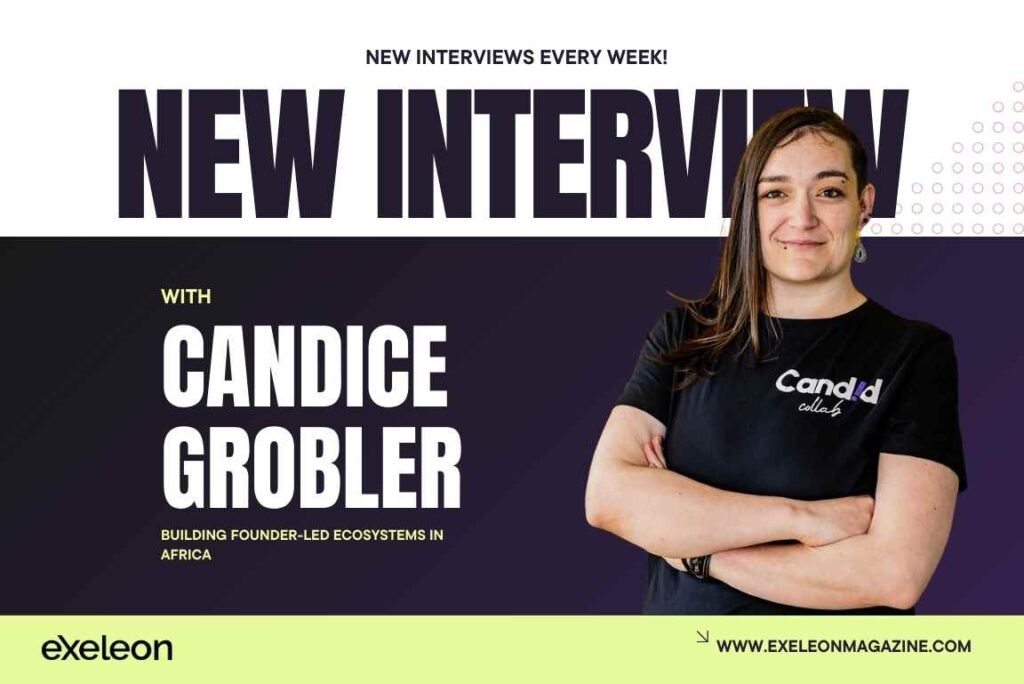
Candice Grobler, widely known as Cands, works at the intersection of community, entrepreneurship, and mentorship across Africa. Through her work at Candid Collab, she helps founders build sustainable, community-led businesses that prioritize trust, shared value, and long-term resilience over short-term growth metrics.
Deeply influenced by lived experience, Ubuntu philosophy, and on-the-ground realities of African markets, Candice Grobler challenges conventional startup thinking and reframes community as a serious business lever. In this conversation, she reflects on what drew her to community-driven models, why mentorship sits at the core of her work, and the kind of founder ecosystem she hopes to help shape across the continent.
Candice Grobler: Your work focuses on helping African founders build community-led businesses rather than chasing short-term growth. What first pulled you toward community as a serious business lever?
When Covid hit, I was retrenched and the events industry I worked in collapsed almost overnight. Every event, online and in-person, disappeared. I took part-time work with a few NPOs (Ubuntu Beds, Khwela Womxn), and that’s where I saw, very clearly, what survives when everything else is stripped away: community.
These organizations had no budget for paid media or fancy branding. What they had was Ubuntu, “I am because we are”, baked into everything they did. The only way to keep their mission alive was to mobilize the people they already had, to gather online in scrappy ways, and to keep connecting humans to humans.
I had to start asking a different question. Instead of “What can we buy to grow?” Candice Grobler: I asked, “What do we already have that we’re underutilizing?” The more I experimented, the more obvious it became that community wasn’t a “nice-to-have” around the edges. It was the only reliable growth engine when budgets disappeared and certainty evaporated.
That experience convinced me that community is not a soft, fluffy add-on. It’s a serious business growth lever, especially in markets where money is tight, trust is fragile, and people have always relied on each other long before they relied on ads.
Candid Collab is described as a mentorship-first studio. Why was mentorship such a non-negotiable pillar for you when designing your business model?
I had the privilege of studying linguistics and philosophy, but I’m not specialized in building startup unicorns. I don’t have every answer or every perspective, and I’m very aware of how far a single viewpoint can take me, and where it starts to limit my thinking.
What I do have is a long track record of people investing in me. Mentors opened doors they didn’t have to open. They gave time, insight, and networks when there was nothing in it for them. I hacked my way into the work I do now because others held the door, even when I wasn’t the obvious or most polished choice.
So when I started Candid Collab, I knew I didn’t want to stand on a pedestal as a guru with a perfect blueprint. I wanted to build a mentorship-first studio that treated knowledge and relationships as something we steward collectively, not something I own.
That’s why we start with mentorship, not coaching. We don’t arrive with a rigid playbook and tell founders “the way”. We work with what they already have, in the language they naturally use, and we co-design scrappy systems that make sense for their reality. Many of the founders I work with have advanced thinking but not always the same academic vocabulary. Mentorship lets us meet them where they are, instead of asking them to perform fluency in someone else’s jargon.
Underneath it all is Ubuntu again. I am where I am because others invested in me. Candid Collab is how I keep that investment moving forward.
The Founder Hivemind has become a core offering within Candid Collab. What gaps did you see in existing founder communities that inspired you to build it?
Most founder communities are designed for people who have already “made it”, high revenue, warm networks, and a level of access that filters out the very people who could benefit most.
I kept seeing membership thresholds like “minimum R5 million in annual revenue” just to apply. That might make sense for certain models, but it sends a quiet message: there is one acceptable way to build a business, and it looks a lot like Western, venture-compatible growth.
Meanwhile, I was meeting founders across Africa earning under R500,000 a year who were solving real problems in their communities, often as the primary breadwinners in their families. Many are neurodivergent, many didn’t have reliable access to education, food, or study environments, but they see opportunity where others only see crisis.
These founders rarely have the time or money to join elite communities, yet they are the ones for whom a small shift in information, the right 20 percent, can unlock 80 percent of the impact.
The Founder Hivemind grew out of wanting to build for them: a space where community-centric, context-specific ways of doing business are not treated as edge cases but as the main story. I’m far more interested in helping a founder become a self-sustaining, trusted node in their community than in helping someone optimize their third investment round.
For me, that’s also part of a bigger conviction. Africa has everything it needs, resources, creativity, problems worth solving, to host the next great wave of entrepreneurship. That won’t come from extracting more from workers. It will come from equipping more people to become owners.
How do African market dynamics shape the way community, trust, and participation need to be built compared to more mature startup ecosystems?
Candice Grobler: Vusi, the founder from Kasi Catalyst in Cape Town, once laughed kindly when I spoke about “building” community. I’m grateful she reminded me that, in many African townships, community is the default setting. People survive because they share. They raise kids together, borrow sugar from next door, and informally redistribute what little they have.
So in Africa, the challenge is not building community from scratch. It is building trust around new kinds of participation and educating people on how to engage with the formal economy without losing the informal support systems that keep them alive.
Many people here still live on almost nothing, and yet they continue to provide for each other. That is real value, even if balance sheets don’t capture it. When global markets value compound interest over collective care, it exposes how misaligned the system is.
Practically, this shapes how I think about community-led businesses. Digital tools are powerful, but not always accessible or intuitive. Data is expensive. Devices are shared. People are used to seeing each other in person, so asking them to move their sense of belonging into an app is a big leap.
WhatsApp, for example, is ubiquitous and incredibly effective, and also messy, unregulated, and not always compliant. It’s where people already are, but it carries risk. So community work here becomes an exercise in translation: bridging offline trust to online spaces, using channels people already understand, and designing participation that respects both the constraints and the existing social fabric.
What has been the most rewarding transformation you have witnessed from a founder you have worked with through Candid Collab?
Candice Grobler: About a year ago, a neurodivergent founder came to me after being pushed out of a long-term contracting role. For the first time in more than 50 years of working, she asked for reasonable accommodations. The response was to end the contract. By the time we met, she was shaken, doubting whether she could ever create work that truly fit her needs.
She disliked sales, had never freelanced, and had no interest in building or managing a client pipeline. We started small: clarifying what she could take off small-to-medium enterprises’ plates, designing offers that matched her strengths, and building support structures around her energy and focus rather than against them.
Today, she runs her consulting business full-time. She has launched her own course to generate leads, built marketing assets that feel sustainable, even without loving the camera, and grown a network that actively refers work her way. She has collaborated with institutions like INSEAD and with other founders in our community, not just to build a portfolio, but to prove to herself that she belongs in those rooms.
The biggest shift isn’t only in revenue or brand names. It’s in her posture. She now trusts that she can run a business on her own terms, with the accommodations she needs, while serving her clients and her community well. Watching that level of self-trust rebuild itself has been one of the most rewarding parts of my work.
Finally, when people think of Candid Collab in the years ahead, what impact do you hope it will have had on Africa’s founder landscape?
My long-term vision is to help a million people become self-employed founders who are building community-centric businesses. Not empire builders in the traditional sense, but people who are deeply rooted in their communities and able to sustain themselves and others.
I would love Candid Collab to become a kind of quiet badge of honor, a signal that someone hacked their career in unconventional ways, refused to shut the door behind them, and is now actively holding it open for others.
If, years from now, there is a visible wave of African founders who talk about community first, profit as a tool rather than the only goal, and mentorship as a responsibility rather than a favor, I will be proud to have played a small part in that.
Ultimately, the impact I care about is simple: more founders who are self-sufficient, more communities that are less dependent on extractive systems, and more people who can say, Candice Grobler: “I built this with my people, and now I’m helping the next person do the same.”
Read Digital Version of this Issue.
Follow Candice Grobler on Instagram.
Contact Candice Grobler on LinkedIn.