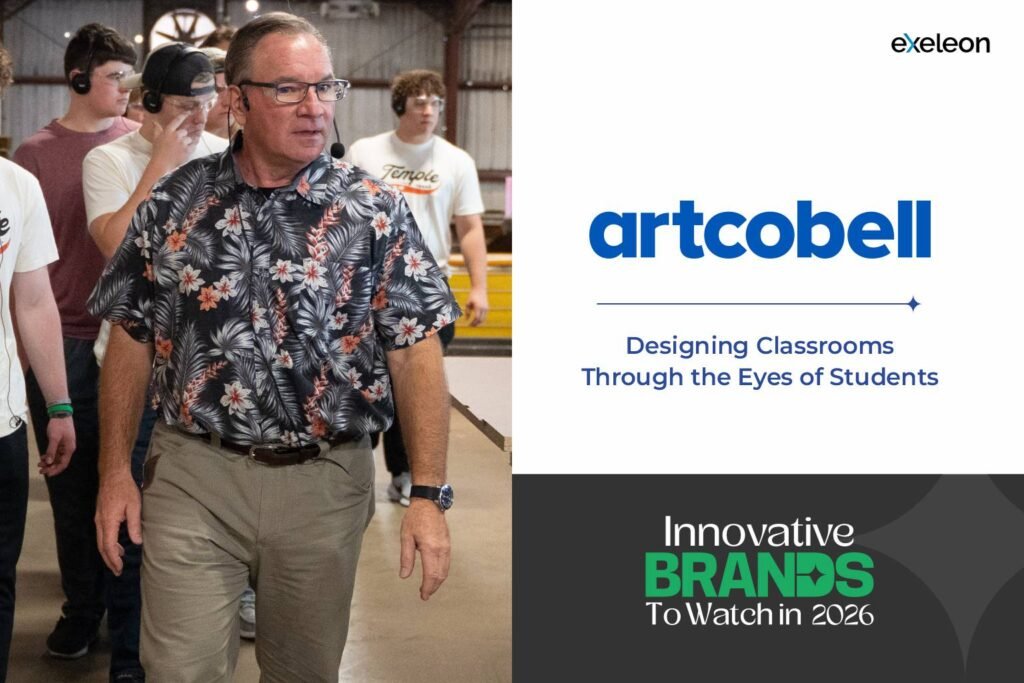
For decades, classroom furniture was rarely part of the conversation around educational success. Discussions focused on curriculum, teaching methodologies, technology, and student performance, while desks and chairs remained largely viewed as functional necessities. Yet every student spends thousands of hours interacting with their learning environment, and the design of that environment can influence everything from engagement and collaboration to comfort and confidence.
Artcobell recognized this reality long before it became a broader industry conversation.
Headquartered in Temple, Texas, Artcobell has spent more than half a century serving schools across the United States. What began as an art supply business in 1965 eventually evolved into one of the country’s leading educational furniture manufacturers. Today, however, the company sees itself as something far greater than a furniture producer. Its mission is centered on creating learning environments that help every student succeed, regardless of learning style, physical ability, or individual needs.
That shift in thinking has transformed Artcobell from a manufacturer of classroom products into a company helping shape the future of education itself.
At the center of this evolution is a simple but powerful philosophy known as Through Their Eyes, a student-first approach that challenges educators, designers, and manufacturers to view every classroom from the perspective of the children who learn within it.
As schools continue to rethink how learning happens, Artcobell is proving that innovative classrooms begin with understanding the students they serve.
A Legacy Built on Solving Classroom Challenges
Artcobell’s story began in Temple, Texas, where the company was founded in 1965. Over the years, it expanded beyond art supplies and entered the educational furniture industry through strategic growth initiatives, including the acquisition of American Desk.
While the business evolved, one principle remained consistent: finding practical solutions to challenges faced by schools and educators.
According to President Kevin Smith, the company’s history has always been defined by a willingness to say yes to difficult problems.
Rather than simply manufacturing furniture, Artcobell focused on understanding classroom realities and creating products that addressed them. This approach allowed the company to develop a deep connection with educators and administrators while building a reputation for quality and reliability.
Over time, however, the company began asking a more important question.
Instead of focusing solely on what schools needed, what if every design decision started with understanding what students needed?
That question would eventually become the foundation of Artcobell’s modern identity.
Moving Beyond Furniture
About five years ago, the educational furniture market underwent significant change. New manufacturers entered the industry, competition intensified, and product differentiation became increasingly difficult.
For many organizations, the response would have been to compete on price or production volume.
Artcobell chose a different path. The company stepped back and reevaluated its purpose.
“We realized we don’t just make furniture,” explains Kevin. “What truly distinguishes us is our focus on creating high-quality products specifically designed for students.”
That realization sparked a deeper transformation.
The company began viewing itself not as a furniture manufacturer, but as a contributor to student success. Every design discussion, product development initiative, and strategic decision became connected to a larger goal of supporting learning outcomes.
This shift fundamentally changed how Artcobell approached innovation.
The focus moved away from simply creating products and toward designing experiences that help students learn more effectively.
Understanding the Modern Classroom
Education today looks very different than it did even a decade ago.
Traditional classrooms were often designed around uniformity. Rows of desks faced a teacher standing at the front of the room. Students were expected to learn in largely identical ways.
Modern educators understand that reality is far more complex.
Every classroom contains students with different learning styles, sensory preferences, communication needs, physical abilities, and attention patterns. What helps one student thrive may create obstacles for another.
Artcobell has embraced this reality as a central design principle.
“No two students have the same needs,” says Kevin. “What works for one student may not work for another, so learning environments must be adaptable and inclusive.”
The company believes effective learning environments should be dynamic rather than static. Today’s classrooms must support collaboration, independent learning, movement, creativity, and focused concentration simultaneously.
This philosophy has influenced the development of mobile desks, movement-based seating, flexible learning pods, soft seating solutions, and furniture systems that can easily adapt throughout the school day.
Rather than forcing students to conform to a space, Artcobell designs spaces that adapt to students.
The result is a learning environment that encourages engagement, accommodates diverse needs, and supports more personalized educational experiences.
The Story Behind Through Their Eyes
Perhaps the most defining initiative in Artcobell’s recent history is Through Their Eyes.
More than a campaign, it represents a complete shift in perspective.
The idea emerged from a deceptively simple question: What would happen if classroom furniture designers viewed every decision through the eyes of an eight-year-old child?
The company challenged itself to revisit its own educational experiences and imagine classrooms from a student’s perspective.
What made learning easier? What created frustration? What helped students feel comfortable, included, and motivated?
The answers revealed opportunities that traditional design approaches often overlooked.
Through Their Eyes became a framework for understanding the diverse realities students face every day.
“We put ourselves in their shoes,” Kevin explains. “We tapped into our inner eight-year-old and asked what we would have wanted in our classroom.”
The initiative quickly evolved into something much larger than product development.
It became a call for the entire industry to rethink how educational spaces are designed.
Rather than treating students as end users, Artcobell encourages educators, manufacturers, and decision-makers to place students at the center of every conversation.
Designing for Every Learner
One of the most innovative elements of the Through Their Eyes initiative is the development of ten student personas.
These personas represent a wide spectrum of learners, including students with varying sensory needs, physical abilities, neurodiverse experiences, and learning preferences.
Instead of designing furniture for an abstract concept of a student, Artcobell designs with real-world scenarios in mind.
The company regularly asks itself important questions throughout product development.
Would this solution support a student who struggles with sensory overload?
How would it serve a student who benefits from movement throughout the day?
Does it help students collaborate effectively while still allowing opportunities for focused independent work?
Could it better support learners with physical challenges or unique educational needs?
These questions drive innovation across the organization and ensure that products are evaluated through multiple perspectives.
This level of intentionality has become one of Artcobell’s defining strengths.
Rather than creating products for the average learner, the company works toward creating environments where every learner can succeed.
A Culture Driven by Purpose
Innovation rarely happens in isolation.
Behind every successful product is a team united by a shared mission.
At Artcobell, culture plays a critical role in maintaining the company’s student-centered focus.
According to Kevin, the organization’s culture is deeply collaborative and purpose-driven. Employees understand that their work ultimately impacts classrooms and students across the country.
The Through Their Eyes philosophy is visible throughout the company’s offices, manufacturing facilities, and internal communications. It serves as a constant reminder of why the work matters.
When projects become challenging or deadlines become demanding, employees reconnect with the broader mission.
They are not simply building furniture.
They are helping shape environments where students learn, grow, collaborate, and discover their potential.
That sense of purpose has become a powerful driver of innovation and employee engagement alike.
Shaping the Future of Education
Looking ahead, Artcobell’s vision extends far beyond manufacturing.
The company believes that learning environments play a critical role in shaping educational outcomes and student well-being.
While schools cannot control every factor influencing a child’s success, they can influence the environment where learning happens every day.
That responsibility drives Artcobell’s long-term mission.
The company remains committed to creating learning spaces that provide flexibility, support, safety, and opportunity for all students. Whether serving learners with significant support needs or students seeking greater independence and collaboration, the goal remains the same: helping every child reach their full potential.