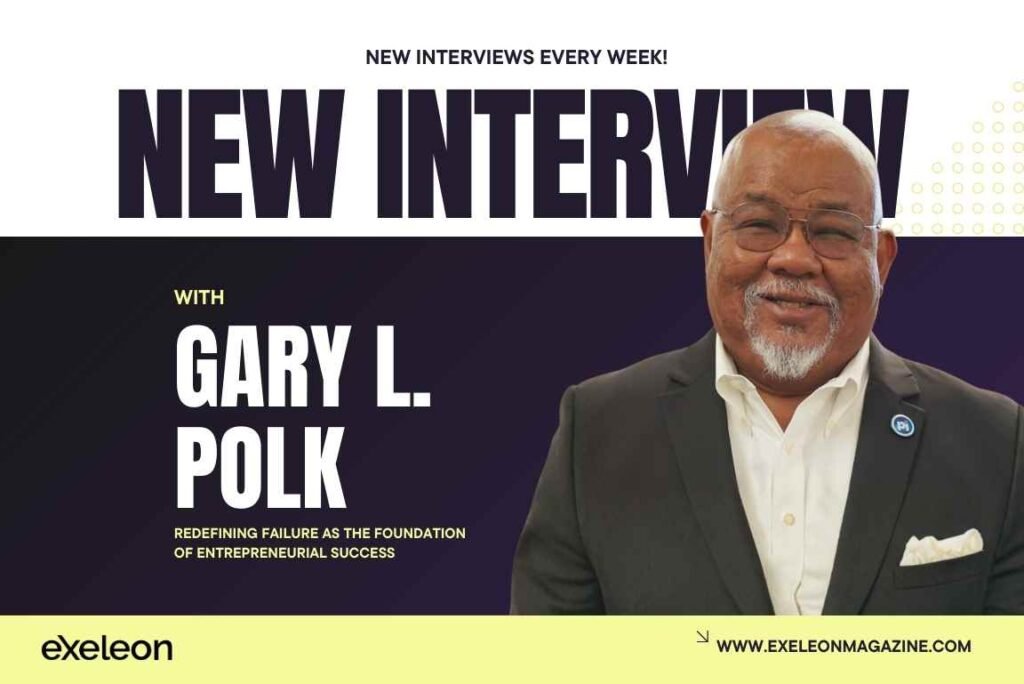
Gary L. Polk career is defined by a rare blend of real-world financial expertise, academic leadership, and a lifelong commitment to empowering entrepreneurs. With decades of experience spanning banking, entrepreneurship, education, and nonprofit leadership, Polk has dedicated his work to helping founders understand one critical truth: failure is not the opposite of success, but its foundation. As the author of the widely adopted Why Entrepreneurs Fail (To Win) trilogy and the founder of the Polk Institute Foundation, he has championed a new generation of ethical, resilient, and fundable CEOs.
His mission goes beyond business success; it is about building leaders with character, vision, and the courage to pursue their entrepreneurial dreams.
In this interview with Exeleon Magazine, Gary Polk shares the lessons that shaped his philosophy, the realities entrepreneurs must embrace, and his vision for developing ethical leaders who redefine success through resilience, character, and purpose.
Your journey spans banking, insurance, academia, and entrepreneurship. What experiences shaped your passion for helping entrepreneurs succeed and understand why they fail?
This is a great question. My passion began during my final assignment as a banker at the Bank of America Beverly Hills Main Branch, where I noticed that the average people who lived in Beverly Hills were entrepreneurs and small business owners — not corporate officers. Then, three years after I began teaching entrepreneurship at CSU Northridge, I discovered that teaching was my true passion. This is when I started to develop the analogy that entrepreneurship is like baseball — both are failure sports. A baseball batter who hits only 3 of 10 pitches may be considered a failure in most circles, but as a baseball player, he is a Hall of Famer. We know that 3 of 10 startups fail as well. Both are, indeed, failure sports.
Your book Why Entrepreneurs Fail (To Win) has become widely used in entrepreneurship programs. What is the most important lesson entrepreneurs must learn early to avoid failure?
Failure CANNOT be avoided. Failure is part of the game — failure is actually a good thing. To fail is acceptable, as long as we do not QUIT. To learn from our failure and NOT quit is perfectly fine. To fail and quit is NOT. After all, failure can be the BEST teacher in the world.
You’ve written extensively about Black, Brown, and women entrepreneurs. What unique challenges do these groups face, and what must change to create more equitable opportunities for success?
I am glad you asked that question. When I wrote my first book, I approached it with the mindset that it would be my first and last, but I had so much fun in the process that we decided to write a second book, Why Black & Brown Entrepreneurs Fail (To Win). During our research, we found that Black and Brown entrepreneurs oftentimes lack the self-confidence to take the risks that all entrepreneurs must embrace. We call this Self-Doubt. So, we posed the fundamental question: Does Self-Doubt hold you back from becoming an entrepreneur? Sometimes this Self-Doubt comes from family and friends, sometimes from those within our own race, sometimes from the majority race, and sometimes from between our own ears. Regardless of the source, we CANNOT allow Self-Doubt to hold us back from taking the risk to pursue our entrepreneurial dreams. Be resilient. You can do it! Yes, you can!
After writing our second book, we decided to complete a trilogy by focusing on Why Women Entrepreneurs Fail (To Win). For this effort, I called on a female colleague from CSUDH, where I also teach, Dr. Jennifer Brodman, who had just completed her scholarly research on women and access to capital. We decided to open Chapter 1 with a compelling discussion on Access to Capital. During our research on women entrepreneurs, we found that women have a propensity to keep things grounded in reality. In other words, women entrepreneurs can sometimes be too pragmatic when setting goals. In their quest to not over-promise and under-deliver, they can set their sights very conservatively. This became the focus of Chapter 4: “Is Being Too Pragmatic Holding You Back from Dreaming Big?”
Once we move past these two key issues addressed in our second and third books, Black and Brown entrepreneurs and women entrepreneurs must contend with the same challenges as ALL entrepreneurs – management, marketing, promotion, sales, and financial management.
Finally, to address your closing question, what changes must be made, there are no silver bullets. I will conclude by identifying three attributes that all entrepreneurs must possess: 1) Resiliency, 2) Resourcefulness, and 3) Building a Team. We can control ourselves, but we cannot control others. To worry about things beyond our control is a source of unnecessary stress. My best advice is to focus on what we can control.
Through the Polk Institute Foundation, you focus on developing ethical, fundable CEOs. What inspired you to create this platform, and what gap were you determined to fill?
The CEO Gap! Anyone can start a new business and claim to be a CEO — but a true CEO is what we call the Fundable CEO. The Polk Institute is dedicated to developing the Fundable CEO who also possesses strong Character and a high degree of ethics.
One of my colleagues, Dr. Fred Haney, published a great book in 2018 called The Fundable Startup, and after reading it, the concept of the Fundable CEO was born. We define the Fundable CEO as a person who can do three things:
- Articulate a Mission and Vision that is engaging and inspiring;
- Recruit a Team of Co-Founders to help achieve that mission and vision;
- Assemble the other critical elements needed for a startup — financial, human resources, legal, and accounting resources necessary to launch a million-dollar business.
As an Influential Black Leader, how do you see your role in shaping the next generation of diverse entrepreneurs and redefining leadership?
To be clear, my role can best be defined as educator, teacher, and trainer. I have been blessed with a quality education and vast financial experience from my 10-year career in banking, and I have had the privilege of touching the lives of diverse students at CSUDH and CSUN as a college lecturer since 1991. My 14 years as a high school and college-level basketball coach gave me the unique opportunity to work with both athletes and aspiring CEOs and I have found the two to be remarkably similar in their makeup. Both are alpha-type personalities, both have a fierce desire to compete and win, and both can fail. After all, at the end of the day, entrepreneurship is truly a failure sport.
Speaking of the next generation, since 2017 I have championed the Triple Bottom Line — the 3 Ps: People, Planet, and Profit. My Generation Z students have embraced this framework as a better model of entrepreneurship and small business. Many will tell you that the Triple Bottom Line is a zero-sum game — that is NOT true. All three can and do coexist.
As a Baby Boomer, I was taught that the business of business is business, which ultimately equates to the belief that profit reigns supreme. As a college educator, I can attest that MBA programs have long taught profit maximization as the gold standard. I believe both of these frameworks are incomplete. Business is far more than profits. Profit maximization can push decision-making past ethical boundaries and in my personal view, teaching it without that caveat does a disservice to the next generation of leaders.
Ethics and character must be woven into our very definition of the Fundable CEO. At the Polk Institute Foundation, our number one value is Character — Doing the Right Thing When No One Is Watching.
Looking ahead, what legacy do you hope to leave through your books, your students, and the Polk Institute Foundation?
It is my sincere hope that the legacy of the Polk Institute is one of Integrity, Hope, Resilience, Resourcefulness, Ethics, and Character. My books are intended to serve as a source of empowerment, guiding todays and future generations on what it truly takes to become a Fundable CEO: a Social Entrepreneur who champions the Triple Bottom Line of People, Planet, and Profit.
Read Digital Version of the Edition.