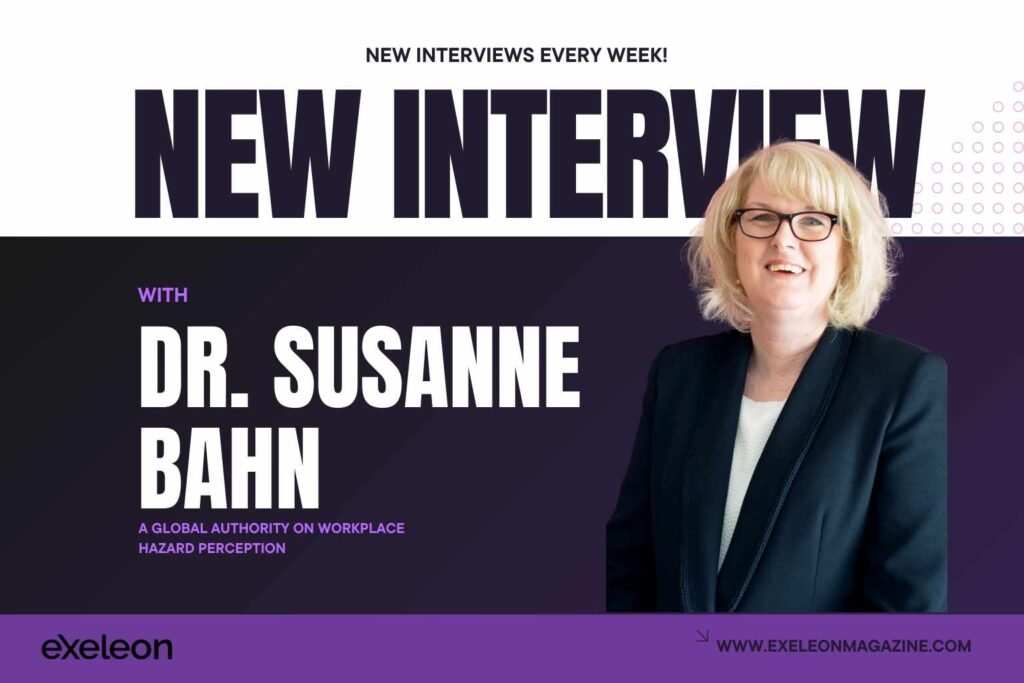
Dr. Susanne Bahn is widely recognized as a global authority on workplace hazard perception and risk blindness in high-risk environments. With a background in safety consultancy and academic research at Edith Cowan University, she has spent decades studying why accidents happen and how they can be prevented through better awareness, training, and behavior change.
As the founder of Tap into Safety, Dr. Bahn has translated research into practical, scalable solutions that help organizations move beyond compliance toward genuine safety culture transformation.
In this interview with Exeleon Magazine, she shares what led her into this field, the gaps she observed in traditional safety training, and the impact she hopes to continue making in workplaces worldwide.
Dr. Susanne Bahn: You are widely regarded as a global authority on workplace hazard perception. What initially drew you to studying hazard awareness and risk blindness in high-risk work environments?
My interest came mainly out of frustration at seeing regular workplace accidents that could have been avoided if workers were taught to look up, look down, and look around before they completed a task. There was also an obvious complacency of “it won’t happen to me,” particularly among young workers who think they are “bulletproof” and older workers who “have always done it this way.” I wanted to come up with some solutions and strategies that organizations could easily adopt to improve hazard awareness skills.
Before founding Tap into Safety, you spent years in safety consultancy and research at Edith Cowan University. How did these experiences shape your understanding of the gaps that existed in traditional safety training?
Being involved with organizations and discussing issues with safety managers confirmed the need to tackle risk blindness at the worker level. There’s nothing like hearing from supervisors and safety managers about their frustrations, as well as from the workers themselves, about the disconnect between what is written in safe operating procedures and the way work is actually done.
Tap into Safety was created in direct response to industry needs. Can you share the key insights or pain points you heard from companies that inspired you to build the TIS Training Platform?
Organizations are always looking for ways to improve their safety performance and reduce injuries. As they grow and expand to operate across sites that are away from head office, managing their people becomes far more difficult. This shows up quite prominently when they need to deliver training. When we started TIS, many organizations were still trying to do this face to face using PowerPoint presentations.
Research shows that after the first seven minutes of any training, the mind starts to drift and people think about other things. Therefore, if you want to get a critical message across, you need to do it very quickly.
As soon as you have multiple sites delivering training, the issue becomes ensuring a consistent message. This doesn’t happen when you rely on trainers who are likely to be different people.
Training delivery also needs to suit the learner. Young people are constantly watching videos and no longer accept PowerPoint or traditional classroom settings. Their attention span is limited, and they expect more.
Tap into Safety also offers mental health training using a microlearning format. Why was it important for you to integrate mental health alongside hazard awareness and safety training?
There’s a global recognition that a person’s psychological health directly affects their focus and attention. When your mind is not on what you’re doing, you are more prone to accidents.
Beyond compliance, many organizations are now looking to transform their safety culture. How does the TIS Platform help them move from “checking boxes” to truly changing behavior?
There’s always a need for straightforward compliance training such as onboarding and induction. However, if you do that right, you can ensure the new worker understands their obligations and has information on what can hurt them and others they are working with.
Once a person is settled into their role, there is a need to ensure they are regularly reminded about hazards in the organization’s working environment because humans grow complacent. As you might know, it takes seven times before new information is committed to memory. The key is to mix it up and provide different types of training to reinforce the same message. Repetition changes behavior, and it shows that the organization is committed to safety and that it is part of their culture, the way things are done around here.
Looking ahead, what emerging risks or challenges do you believe organizations will need to focus on to keep workers safe and well?
To be honest, I don’t think it will be very different going forward. Human brains need repetition to embed safe practices. Generally, literacy levels and attention spans are dropping, so messages need to be delivered simply and quickly.
Finally, what motivates you today as both a researcher and CEO, and what impact do you hope Tap into Safety will continue to create in workplaces around the world?
I like to see injury rates dropping, and I get pretty angry when I hear about a workplace fatality. I know that what we offer through TIS helps organizations provide one important piece of the puzzle in keeping their workers safe. The impact I hope we continue to create is improved safe practice and a reduction in workplace injuries.